


TL;DR
ScrapingBee is a solid proxy-and-render API, but its credit multipliers add up fast and its extraction still leans on CSS selectors. The strongest alternatives in 2026: ScrapeGraphAI for AI-native structured extraction, ZenRows for anti-bot bypass, ScraperAPI for a like-for-like credit model, Bright Data and Oxylabs for enterprise proxy scale, and Apify for prebuilt scrapers.
ScrapingBee earned its user base by making a hard problem feel simple: send a URL, get rendered HTML back, let someone else worry about headless Chrome and proxy pools. If that is all you need, it remains a reasonable tool.
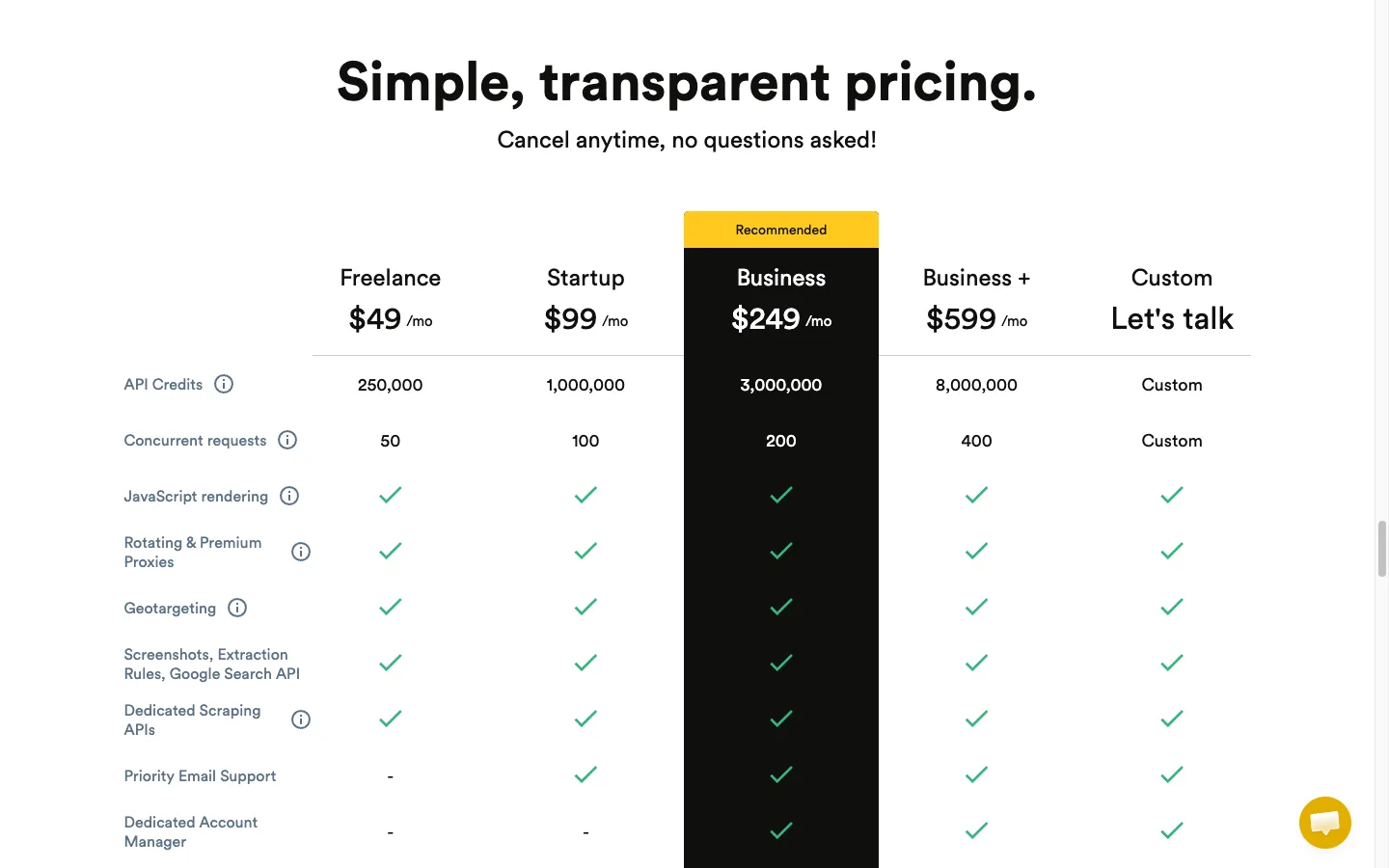
The catch shows up later, in two places. The first is the invoice. ScrapingBee bills in credits, and the multipliers stack: a plain JavaScript-rendered request costs 5 credits, premium proxies push it to 25, and stealth proxies cost 75 credits per request. The 250,000 credits on the $49 Freelance plan can mean 50,000 pages or barely 3,300, depending on which flags your targets force you to enable. The second is the output. Even with extraction rules, you are still writing CSS selectors against markup you do not control, and those break the day the target site ships a redesign.
This guide covers the six ScrapingBee alternatives worth evaluating in 2026, what each one actually costs, and which type of team each one fits. Full disclosure: we build one of the tools on this list. That is exactly why the pricing, credit math, and code sit next to every claim, so you can check them yourself instead of taking our word for it.
What is ScrapingBee?
ScrapingBee is a web scraping API that fetches pages through rotating proxies and headless Chrome, so you do not run browser or proxy infrastructure yourself. You call one endpoint with a target URL; it returns the rendered HTML.
The feature set, as of July 2026:
- JavaScript rendering with waits, scroll, and click scenarios (
js_scenario) - Rotating, premium, and stealth proxies with country-level geotargeting
- Extraction rules: CSS-selector-based JSON output from the page
- AI extraction:
ai_queryandai_extract_rulesparameters that pull data from a page using a plain-language description, for an extra 5 credits per request - Screenshots, Google search endpoint, and dedicated APIs for targets like Amazon and Walmart on higher tiers
- SDKs for Python, Node.js, Java, Ruby, PHP, and Go
Plans run from $49/month (Freelance, 250,000 credits, 50 concurrent requests) through $99 Startup, $249 Business, and $599 Business+, with a one-time 1,000-credit trial and no permanent free tier.
So why switch? Three patterns come up again and again with teams migrating off it:
- Credit anxiety. The gap between 5 and 75 credits per request makes monthly costs hard to predict. Protected targets silently quintuple your burn rate.
- Selector maintenance. Extraction rules are still selectors. The AI parameters help, but they are bolted onto an HTML-first pipeline and priced per request on top of everything else, and there is no schema validation on what comes back.
- Scope. ScrapingBee fetches pages. Crawling a whole site, monitoring pages for changes, or feeding an AI agent requires you to build the orchestration layer yourself.
Each alternative below fixes at least one of these. None of them fixes all three for every use case, which is why the right pick depends on where ScrapingBee is hurting you.
1. ScrapeGraphAI: AI-native extraction instead of credit arithmetic
ScrapeGraphAI started as an open-source Python library and grew into a hosted web scraping API built around one idea: describe the data you want, get validated JSON back. There are no selectors anywhere in the workflow, so there is nothing to fix when a site changes its layout.
Where ScrapingBee treats AI extraction as a per-request add-on, ScrapeGraphAI is AI-native end to end. The platform exposes five endpoints: scrape for rendered pages in markdown or HTML, extract for prompt-and-schema structured extraction, search for querying the web and extracting from results, crawl for multi-page jobs with depth and URL-pattern controls, and monitor for change tracking. Proxy rotation, JavaScript rendering, and anti-bot handling happen inside the API.
Key features
- Natural-language extraction: a one-line prompt replaces your selector file
- Schema enforcement: pass a JSON Schema or Pydantic model and the response is validated against it, so downstream code gets typed, predictable data
- Crawl and monitor endpoints: whole-site extraction and change detection without building an orchestrator
- Agent-ready: official Python and JavaScript SDKs, an MCP server, and LangChain, LlamaIndex, and CrewAI integrations
- Open-source roots: the underlying library is public on GitHub, so you can audit how extraction works
How does ScrapeGraphAI compare to ScrapingBee?
| ScrapingBee | ScrapeGraphAI | |
|---|---|---|
| Primary output | Rendered HTML | Structured, schema-validated JSON |
| Extraction method | CSS selectors, optional AI add-on | AI extraction by default |
| Site redesign impact | Selectors break | Prompt keeps working |
| Whole-site crawling | Build it yourself | crawl endpoint |
| Change monitoring | Not available | monitor endpoint |
| Entry price | $49/month | Free tier, then $20/month |
The trade-off: if your pipeline genuinely needs raw HTML (archiving, diffing markup, feeding an existing parser farm), ScrapingBee's model maps more directly to that job. ScrapeGraphAI's scrape endpoint returns rendered HTML and markdown too, but if you never plan to use AI extraction, you would be paying for capability you ignore.
Here is the whole migration in code. The ScrapingBee version of a product scraper is a request plus a selector map that you maintain forever. The ScrapeGraphAI version is this:
from pydantic import BaseModel
from scrapegraph_py import ScrapeGraphAI

class Product(BaseModel):
    name: str
    price: float
    in_stock: bool

class ProductList(BaseModel):
    products: list[Product]

sgai = ScrapeGraphAI()  # reads SGAI_API_KEY from the environment

res = sgai.extract(
    "Extract every product with its price and availability",
    url="https://example.com/products",
    schema=ProductList,
)

print(res.data.json_data)
The same call works from JavaScript with the scrapegraph-js package. When the target site redesigns its product cards, this code does not change, which is the point.
How much does ScrapeGraphAI cost?
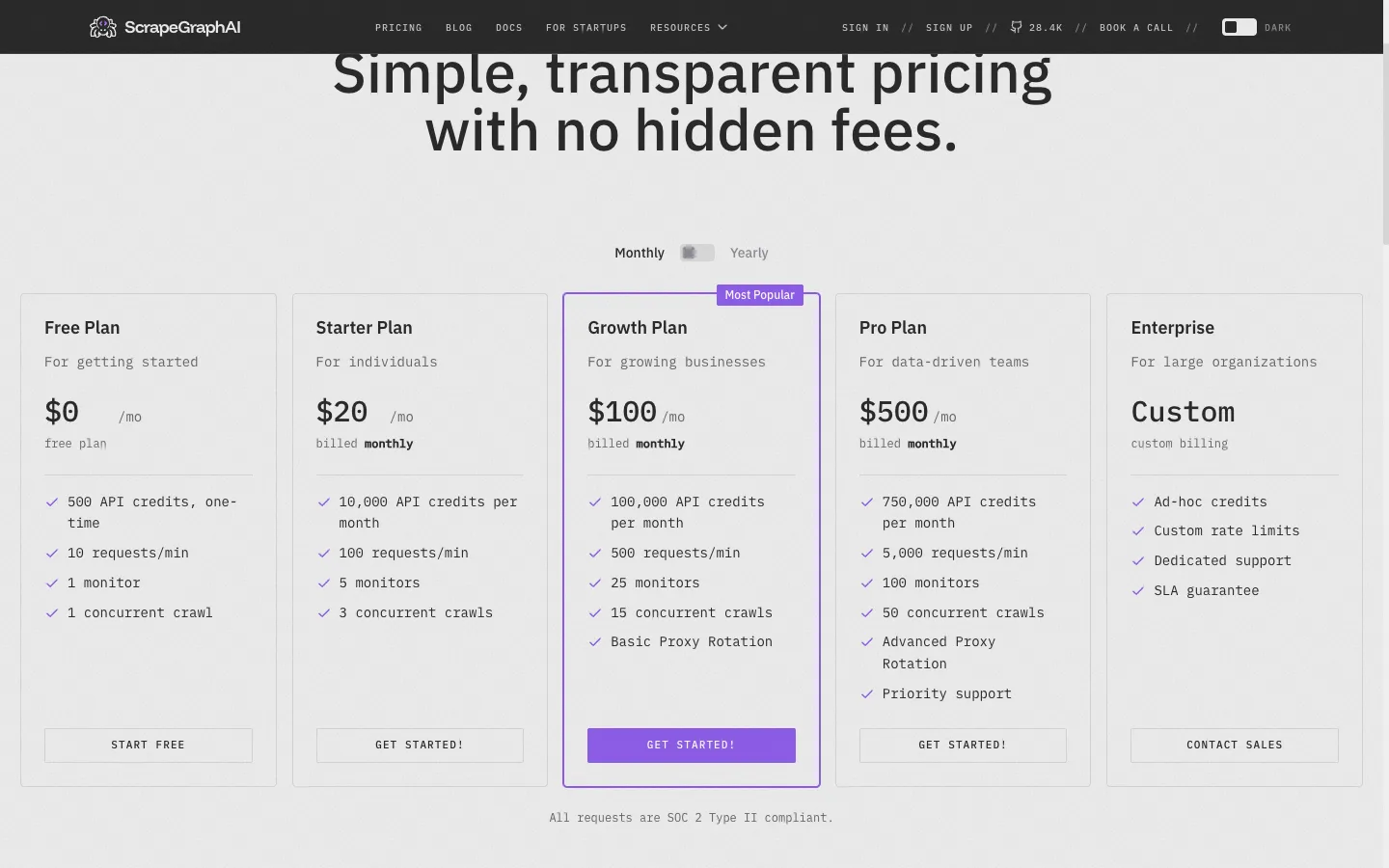
The free tier is enough to prototype against real targets, and it does not ask for a card. Paid plans start at $20/month (Starter, 10,000 credits), then $100 Growth and $500 Pro, with custom enterprise contracts above that. Compared to ScrapingBee, the entry paid plan is less than half the price, and there is no 5x-to-75x credit multiplier tied to proxy class.
When should you choose ScrapeGraphAI?
Pick it when the deliverable is structured data rather than HTML: price monitoring, product catalogs, lead enrichment, RAG ingestion, or anything an AI agent consumes. Skip it if your workload is purely "give me the raw markup and get out of the way."
2. ZenRows: built for the sites that block everyone else
ZenRows is a scraping API whose pitch is anti-bot bypass first, everything else second. If your ScrapingBee requests keep failing on Cloudflare, DataDome, or Akamai targets even with stealth proxies enabled (at 75 credits per attempt), ZenRows is the most direct fix.
Key features
- Anti-bot bypass tuned per protection vendor, updated as the vendors update
- Residential proxy network with geotargeting
- JavaScript rendering with interaction support
- CSS-based output rules, similar in spirit to ScrapingBee's extraction rules
ZenRows vs ScrapingBee
Structurally the two products are close cousins: URL in, HTML out, credit-style billing, selector-based extraction on top. The difference is specialization. ZenRows invests in defeating specific protection systems, and on hard targets its success rate is the reason teams pay for it. On easy targets, the two are interchangeable, and the choice comes down to price and ergonomics.
What ZenRows costs
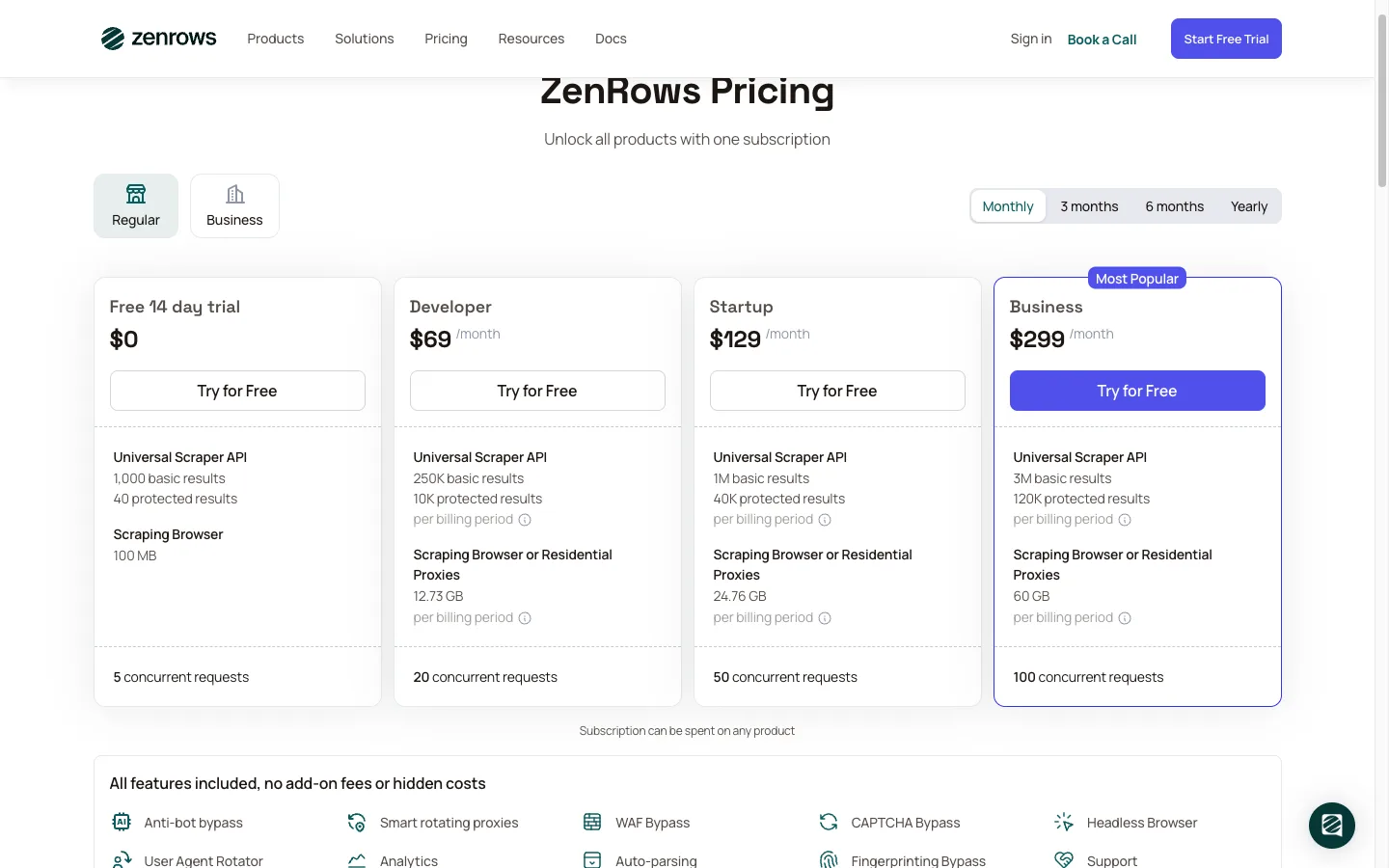
The Developer plan starts at $69 per month (250K basic results), with Startup at $129 and Business at $299, plus a 14-day free trial. Protected sites consume results at a higher rate, so the effective per-page cost depends on your target mix, the same caveat as ScrapingBee's credit multipliers.
Who should pick ZenRows
Teams whose problem is a specific set of heavily protected domains. If those domains are a minority of your workload, weigh whether paying the ZenRows premium across every request makes sense.
3. ScraperAPI: the like-for-like replacement
ScraperAPI is the closest thing to ScrapingBee with a different logo. Same request shape, same HTML-out model, same credit system with multipliers for rendering and premium proxies. That sameness is its value: migration is often a matter of swapping the endpoint and the API key.
Key features
- Proxy rotation with datacenter, residential, and mobile pools
- JavaScript rendering and geotargeting
- Structured-data endpoints for popular targets like Amazon and Google
- Async batch API for large jobs
ScraperAPI vs ScrapingBee
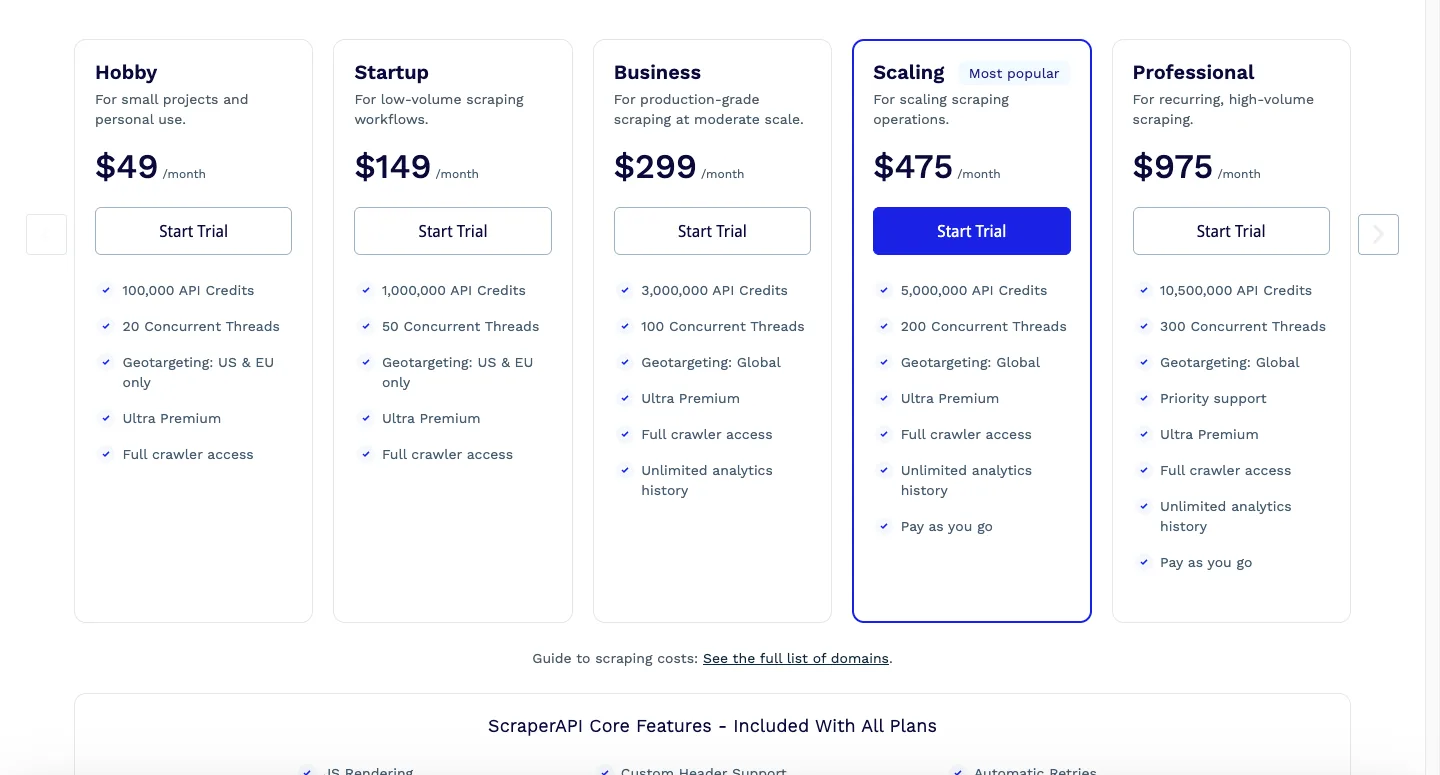
As of mid-2026, ScraperAPI's Hobby plan runs $49/month for 100,000 credits versus ScrapingBee's 250,000 credits at the same price, but the multiplier tables differ, so the only comparison that matters is your own workload priced on both. We ran that exercise in detail in our scraper API cost comparison: the headline credit number and the number of finished pages can differ by an order of magnitude once rendering and premium proxies enter the picture.
ScraperAPI pricing
A 7-day trial with 5,000 credits, then Hobby at $49/month with 100,000 credits, scaling through Startup ($149), Business ($299), and Scaling ($475) as credits and concurrency grow.
Pick ScraperAPI if
ScrapingBee is annoying you for operational reasons, say support, reliability on your specific targets, or a missing feature, but the raw-HTML credit model itself works fine for your team.
4. Bright Data: enterprise proxy infrastructure
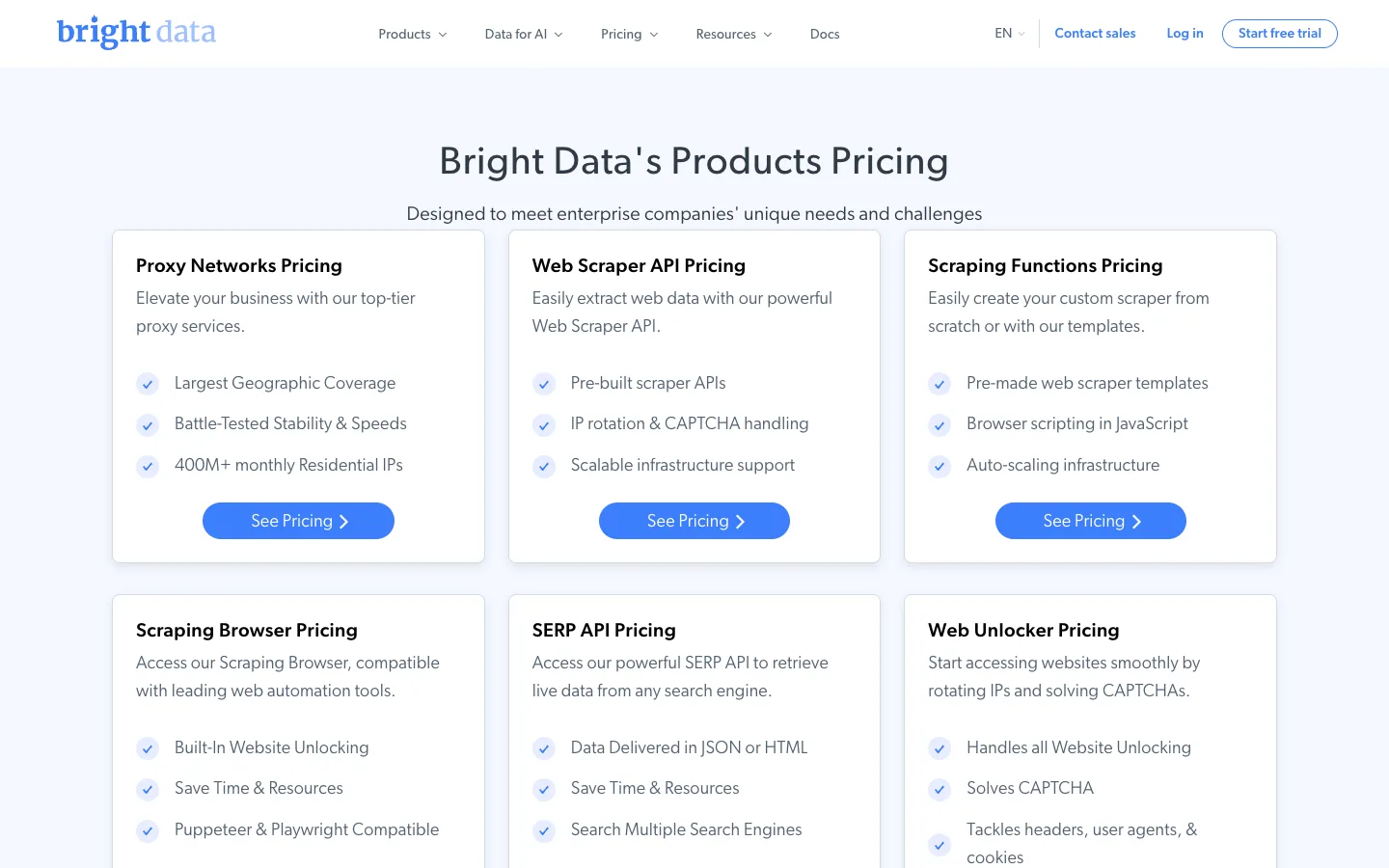
Bright Data is a different weight class. It is not primarily a scraping API but a data infrastructure company: the industry's largest residential proxy network, a Web Unlocker for protected targets, a hosted scraping browser, and ready-made datasets for platforms like Amazon and LinkedIn.
Key features
- 100M+ residential IPs with country, city, and ASN targeting
- Web Unlocker: automatic anti-bot bypass billed per successful request
- Scraping Browser for Playwright and Puppeteer workloads at scale
- Prebuilt and custom datasets if you would rather buy the data than scrape it
Bright Data vs ScrapingBee
ScrapingBee abstracts infrastructure away; Bright Data hands you the keys to it. You get more control and more scale, and in exchange you take on product selection, configuration, and a pricing model that spans several products with usage-based billing. For a small team scraping tens of thousands of pages a month, that is overkill. For millions of pages against hard targets, it is often the only thing that holds up. Our Bright Data alternatives guide covers the reverse migration.
Bright Data pricing
Usage-based and product-dependent: pay-as-you-go proxy traffic per GB, Web Unlocker per thousand successful requests, datasets priced per record. There is no simple monthly number; budget by running a pilot on your real targets.
Where Bright Data makes sense
At enterprise scale, under compliance requirements, or against target sites that defeat every API-tier tool. It is the wrong pick if what you actually want is one endpoint and one invoice.
5. Oxylabs: premium infrastructure with built-in parsing
Oxylabs competes head-to-head with Bright Data on proxy scale, and it has one feature that directly answers a ScrapingBee pain point: its Web Scraper API includes maintained parsers for major targets such as Google and Amazon, so for those domains you get structured JSON without writing selectors.
Key features
- 100M+ residential proxy pool across 195 countries
- Web Scraper API with dedicated parsers for search engines and e-commerce sites
- Web Unblocker with adaptive anti-bot handling
- Enterprise support with dedicated account management
Oxylabs vs ScrapingBee
For the specific sites Oxylabs maintains parsers for, it delivers what ScrapingBee's extraction rules only approximate: structured output that someone else keeps working. Outside that covered list you are back to raw HTML and your own parsing, which is where AI-native extraction still has the edge on generality.
What Oxylabs costs
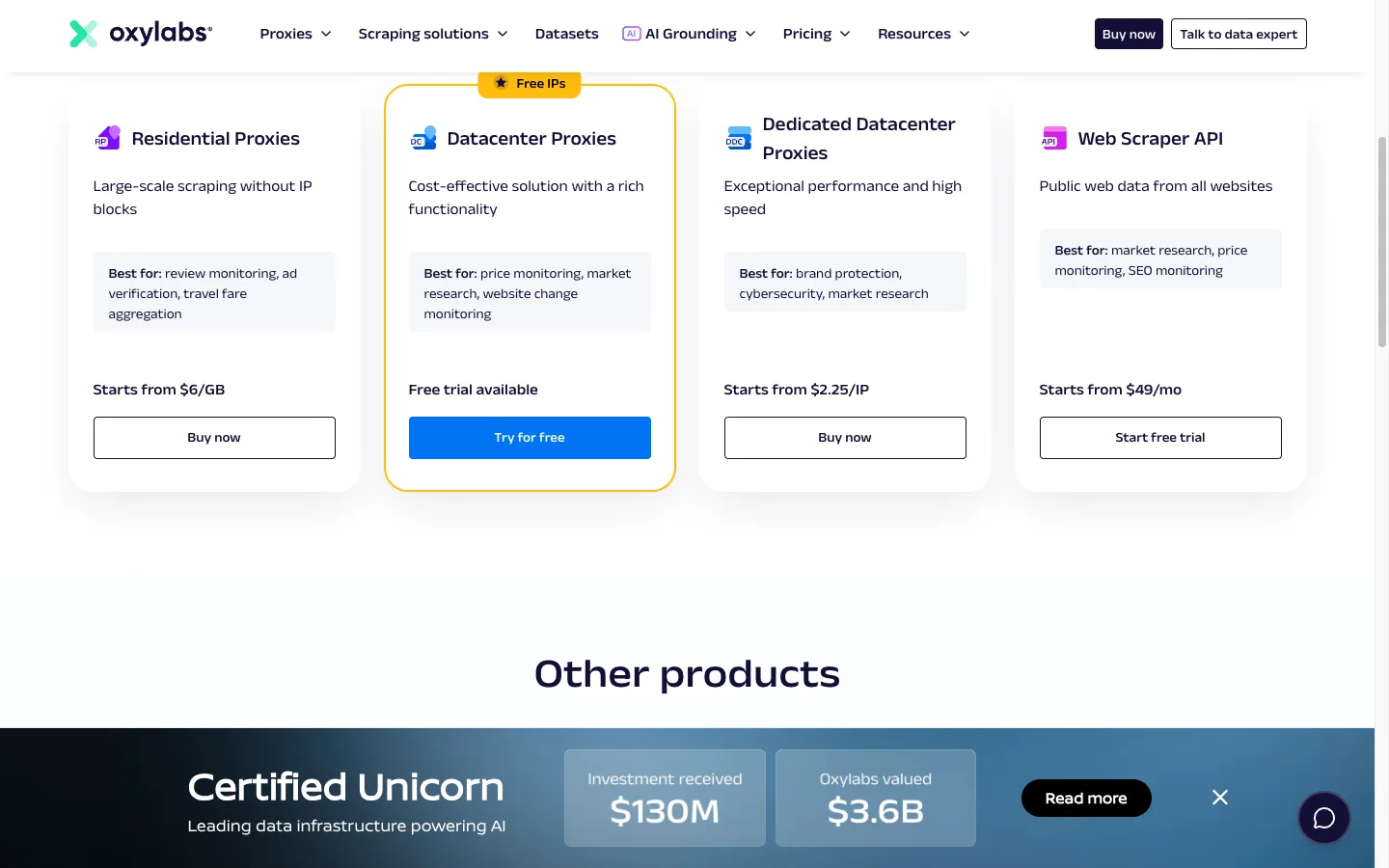
Web Scraper API plans start at $49/month, residential proxies from $6/GB, and dedicated datacenter IPs from $2.25 each. Enterprise agreements are custom.
Who Oxylabs is for
Teams scraping major platforms at high volume where its maintained parsers cover the targets, or teams that want an enterprise proxy layer under their own tooling.
6. Apify: a marketplace instead of an API
Apify approaches the problem sideways: instead of one general-purpose endpoint, it hosts thousands of prebuilt scrapers (actors) for specific sites, plus a platform for running your own Puppeteer, Playwright, or Scrapy code in the cloud.
Key features
- Actor marketplace covering popular targets out of the box
- Hosted execution with scheduling, storage, and webhooks
- Proxy management included in platform usage
- Build-your-own actors when the marketplace falls short
Apify vs ScrapingBee
If an actor already exists for your target, you skip both the HTTP layer and the parsing layer entirely, which is faster to ship than anything else on this list. The risk profile is different, though: community actors vary in quality and maintenance, and platform billing (compute units, storage, proxy usage on top of the subscription) takes effort to predict, something we dug into in our Apify pricing analysis.
Apify pricing
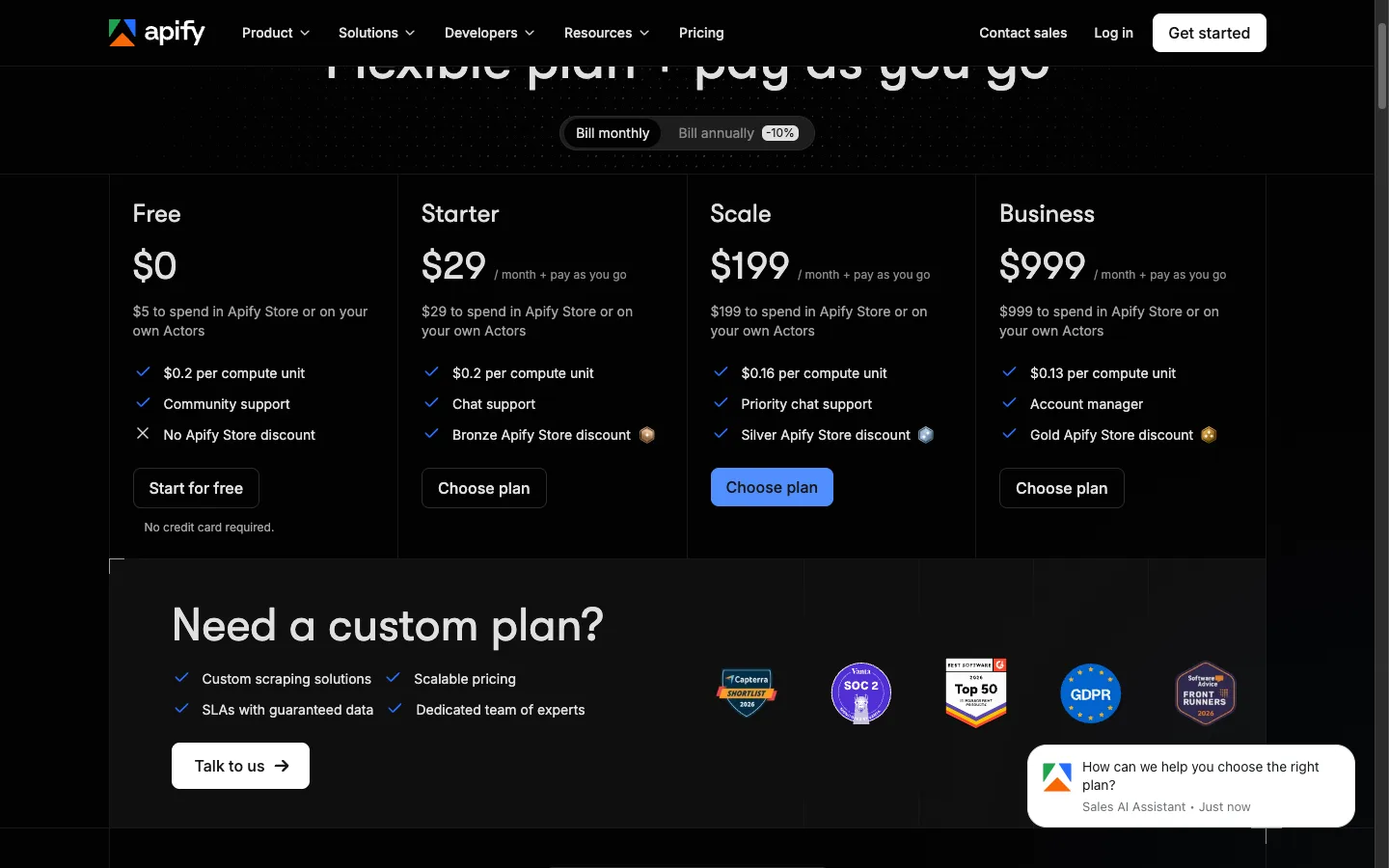
A free plan with $5 of monthly platform credit, then Starter at $29/month and Scale at $199/month as of July 2026, each prepaying the same amount of platform usage. Real cost is driven by compute units ($0.13 to $0.2 each depending on tier) and proxy consumption per actor run.
Where Apify wins
Standard targets where nobody on the team wants to write custom code, and workloads spiky enough that hosted scheduling beats keeping your own workers alive.
How to choose the right ScrapingBee alternative
Map the decision to whichever ScrapingBee problem sent you looking:
- If your parsers keep breaking or you need structured output, go with ScrapeGraphAI. Prompt-and-schema extraction removes the maintenance loop instead of shortening it.
- If your requests keep getting blocked, try ZenRows on an API-tier budget, or Bright Data and Oxylabs when scale justifies infrastructure pricing.
- If the credit math works and you just want a better vendor, ScraperAPI is the lowest-friction swap.
- If your target has a prebuilt scraper, Apify gets you to data fastest.
- If you are feeding LLMs or agents, that is ScrapeGraphAI again: schema-validated JSON, MCP support, and framework integrations mean no glue code between scraping and your AI pipeline.
A one-afternoon pilot on your three ugliest target sites will tell you more than any comparison table, including this one. Every tool here has a free trial or free tier; run the same job through your top two candidates and compare finished records per dollar, not advertised credits.
Frequently asked questions
Does ScrapingBee support AI extraction?
Yes. As of 2026 ScrapingBee offers ai_query and ai_extract_rules parameters that extract data from a description, costing an extra 5 credits per request on top of the base request cost. The difference from AI-native tools is architectural: there is no schema validation on the output, and the AI layer sits on top of a per-request credit meter rather than being the default path.
What is the cheapest ScrapingBee alternative?
ScrapeGraphAI has the lowest paid entry point on this list at $20/month, and a free tier that ScrapingBee lacks (its trial is 1,000 credits, one-time). If what you want is a free ScrapingBee alternative for ongoing use, that free tier is the only permanent $0 option here; the raw-HTML APIs only offer one-time or 7-day trials. Apify's $29 Starter is close on price, but it is prepaid platform usage rather than a fixed request allowance. Among raw-HTML APIs, ScraperAPI matches ScrapingBee's $49 entry price.
Which alternative is best for AI agents and LLM pipelines?
ScrapeGraphAI is the only tool on this list designed for that job end to end: structured output an LLM can consume directly, an MCP server for agent frameworks, and native LangChain, LlamaIndex, and CrewAI integrations.
Do these alternatives handle proxies and CAPTCHAs?
All six manage proxy rotation internally. Anti-bot strength varies: ZenRows, Bright Data's Web Unlocker, and Oxylabs' Web Unblocker are strongest on protected targets; ScrapeGraphAI and ScraperAPI handle mainstream protection automatically; Apify depends on the actor and proxy configuration you choose.
How hard is it to migrate off ScrapingBee?
To ScraperAPI or ZenRows: hours, since the request-response shape is nearly identical. To ScrapeGraphAI: you delete your parsing code rather than porting it, so the work is rewriting call sites, usually a day for a mid-sized codebase, after which the selector-maintenance workload goes away entirely.