


This is the story of how Vibiz AI, founded by CEO Andrei Boca, CTO Lautaro Suarez, and cofounder Angelo Castellani, builds on ScrapeGraphAI to run businesses on autopilot.
TL;DR
Vibiz runs a customer's business on autopilot, and ScrapeGraphAI is the web data layer that feeds it.
- 750K ARR in six months. A four-engineer team launched in January 2026 and scaled fast.
- Two jobs, one data source. LinkedIn lead discovery plus brand knowledge from a customer's own site.
- No backend access required. Vibiz learns what a customer sells by reading their public website.
- Replaced Firecrawl on cost. The same scraping workload for less spend.
- Fresh data is non-negotiable. An autonomous product is only as current as its inputs.
Vibiz turns a URL or a one-line business description into live marketing, creative, and revenue. ScrapeGraphAI is what keeps that engine fed.
What Vibiz Does
Vibiz describes itself simply: run your business with AI. From a URL or a short description, the platform extracts a brand identity, generates on-brand creatives and UGC-style videos, builds landing pages, launches paid ads across Meta, TikTok, LinkedIn, X, and Google, schedules organic posts, and wires up Stripe checkout. The promise on the homepage is "from idea or URL, to live revenue."
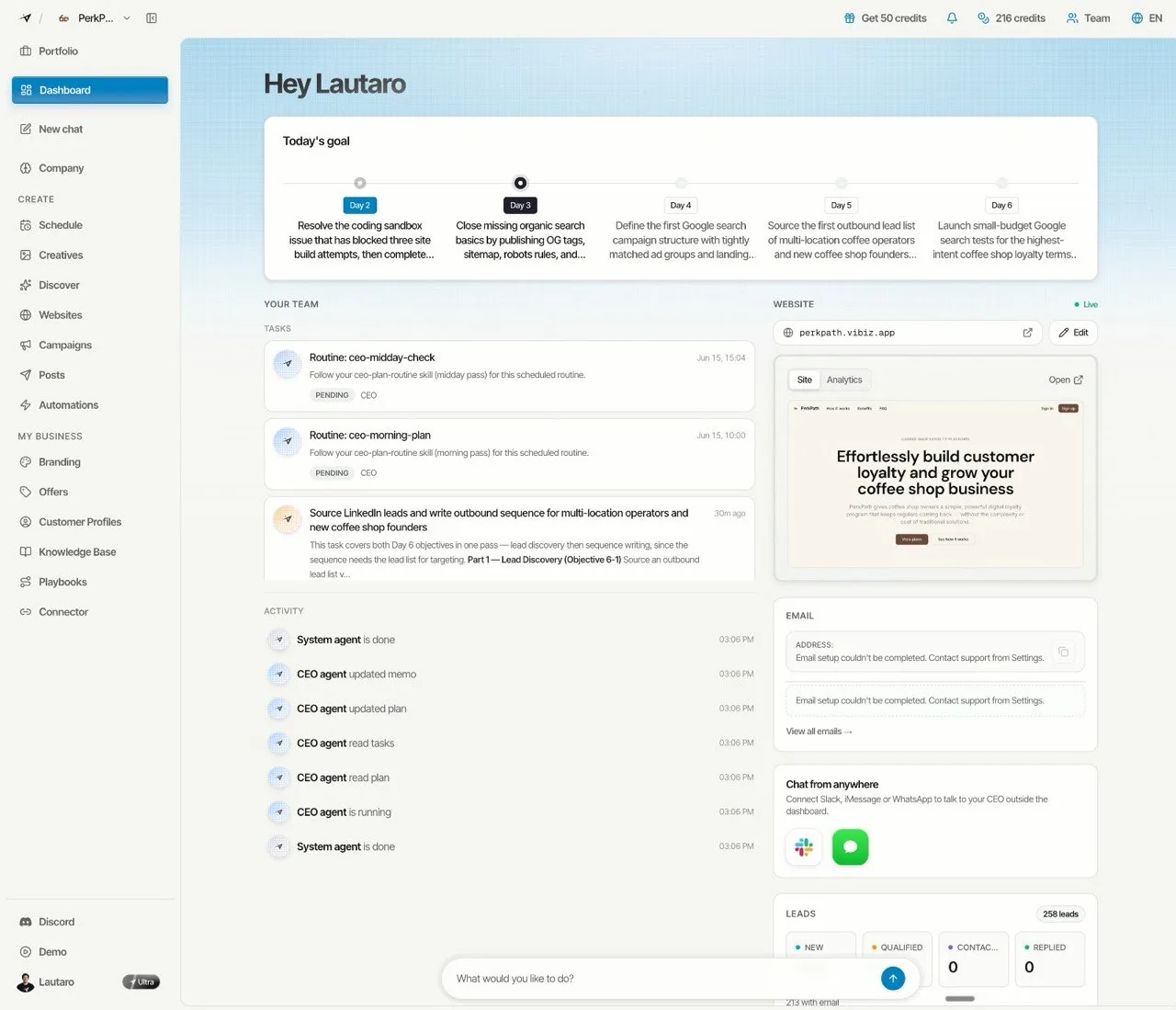
The dashboard runs like an autonomous operator. A daily goal breaks into tasks, agents source LinkedIn leads and write outbound sequences, and the customer's site, email, and lead pipeline sit in one view. Everything on that screen is grounded in data scraped from the open web.
The company launched its product in January 2026. Six months later it reached roughly 750K ARR with a team of eight people, four of them engineers including the CTO. That ratio matters for the rest of this story. A small team cannot afford to maintain brittle scraping infrastructure, and an autonomous product cannot afford stale data.
Vibiz serves a wide range of customers: solo founders and indie hackers, agencies, SaaS companies, e-commerce brands, and local businesses. The common thread is people who want results without a marketing team or a budget to match one.
Why an Autonomous Product Lives on Web Data
Vibiz makes decisions on a customer's behalf. To do that well it needs two kinds of fresh information, and both come from the open web.
The first is who to reach. Vibiz finds leads on LinkedIn that match what a customer's business is looking for, then returns the details that make outreach possible: name, company, email, and enough business context to qualify the match against the customer's own preferences.
The second is what the customer actually sells. Instead of asking a new user to connect a database or export a catalog, Vibiz reads their public website. It learns the site structure, the products, the services, and the pricing plans, then builds a knowledge base that personalizes everything the platform generates afterward. The customer does nothing. They paste a URL and the system understands the business.
Lautaro Suarez, Vibiz's CTO, was blunt about why freshness is not optional. Without current data it is hard to keep customers up to date and surface new ways to improve their business. For a product that runs autonomously, stale inputs mean the platform stops adding value, and customers stop seeing reasons to stay. Fresh web data is a core requirement, not a nice-to-have.
The Coolest and Weirdest Things Customers Build
Two stories capture how adaptable the platform has to be.
One customer is an agency running marketing for a major consumer fintech brand. That is a demanding, high-scrutiny use case, and the platform handles it through the same pipeline everyone else uses.
The other went viral. A small creator selling pet products published a Vibiz-generated video that reached tens of thousands of views, with the product picked and the creative produced almost entirely by the platform off the back of a good scrape. Same engine, wildly different customer. The breadth only works if the underlying data layer works on any site, in any vertical.
Before ScrapeGraphAI: A Patchwork of Vendors
Vibiz did not start here. The early stack was a mix of tools, each covering one slice of the web.
Firecrawl was the primary scraper. Apify actors covered the social platforms, Instagram, Facebook, and LinkedIn, by reusing existing actors so the team avoided building and maintaining their own. A separate ads-data vendor covered Meta and Google ads.
Two problems pushed the team to look for something better.
The first was cost. In the CTO's words, Firecrawl is not cheap, and the spend was one of the main reasons they switched. For a small team scaling quickly, scraping cost was becoming a line item that scaled the wrong way.
The second was freshness on ads data. Their ads vendor was not returning last-day-fresh information, which is a real gap for a platform whose whole pitch is staying current.
Choosing ScrapeGraphAI
Vibiz heard about ScrapeGraphAI through a mutual connection, a common path for fast-moving startups who trust a peer recommendation over a sales pitch.
What made it stick was the combination of lower cost than Firecrawl for the same scraping workload and output that was clean enough to feed straight into Vibiz's pipelines. The team did not want raw HTML to parse. They wanted structured fields they could route directly into lead lists and knowledge bases. ScrapeGraphAI returned exactly that.
How Vibiz Uses ScrapeGraphAI Today
ScrapeGraphAI sits at the top of the Vibiz pipeline, as the intake layer that everything else depends on.
When a new customer signs up, Vibiz scrapes their website to understand the business. It pulls the site structure, the products and services on offer, and the pricing plans, then assembles a per-customer knowledge base. From that point on, every creative, landing page, and campaign is grounded in what the customer actually sells.
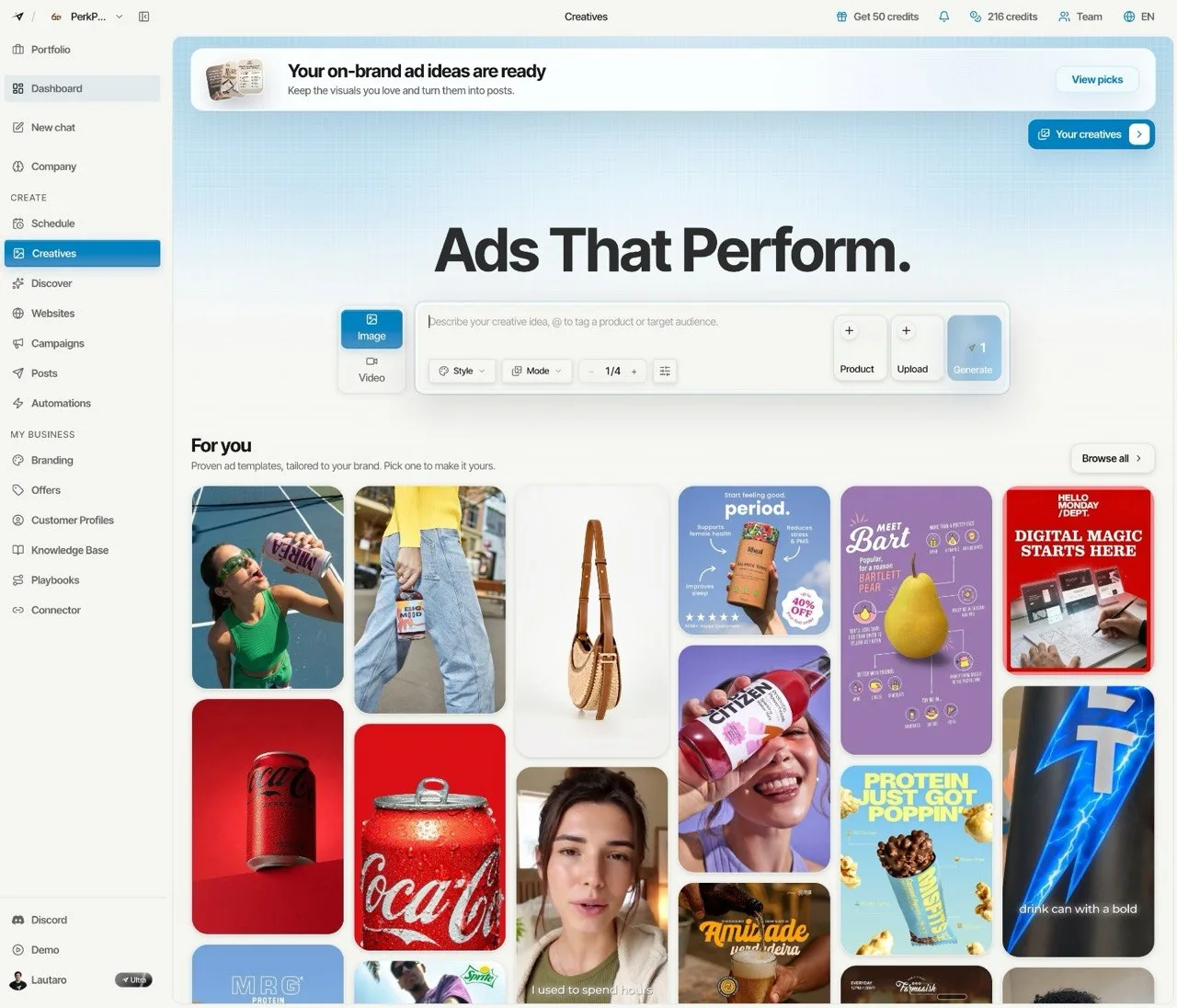
The Creatives surface turns that same brand knowledge into ads that match the customer's products and style, ready to push into campaigns.
In parallel, Vibiz uses ScrapeGraphAI to find and qualify leads on LinkedIn. The platform returns names, companies, emails, and business context, already shaped into the fields Vibiz needs to match each lead against the customer's stated preferences. That matched list flows into outreach and content generation without manual cleanup.
The pattern is the same in both cases. ScrapeGraphAI hands back structured, ready-to-use data instead of pages to parse, and Vibiz spends its engineering time on the product rather than on scraper maintenance.
The Flow, Step by Step
It helps to see where ScrapeGraphAI sits in the customer journey.
- A customer pastes a URL or types a short description of their business.
- Vibiz scrapes the site and extracts structure, products, services, and pricing into a knowledge base.
- That knowledge base grounds the brand identity, creatives, landing pages, and ad copy the platform generates.
- In parallel, lead discovery returns matched LinkedIn contacts that feed outreach and content.
- Campaigns launch across paid and organic channels, with Stripe checkout live from day zero.
ScrapeGraphAI powers steps two and four, the two points where the open web enters the system. Everything downstream depends on those inputs being accurate and current. If the scrape misreads a catalog or the lead data is stale, the generated output drifts away from the real business. Getting that intake layer right is what lets the rest of the platform stay hands-off.
Why ScrapeGraphAI Fit a Small, Fast Team
Three things made the difference for a four-engineer team.
Structured output meant no parsing layer to build or babysit. The data arrived in the shape Vibiz needed.
Reliability across very different websites meant the same pipeline worked for an e-commerce store, an agency, and a solo creator without per-site tuning. The platform handles proxy rotation, anti-bot challenges, and dynamic content behind the scenes.
Lower cost meant scraping stopped being a spend problem as Vibiz grew. The team could increase volume without watching the bill scale faster than revenue.
For a company adding customers quickly, that last point compounds. Every new signup triggers a fresh website scrape and ongoing lead discovery, so scraping volume tracks growth almost one to one. A pricing model that punishes scale would have forced hard tradeoffs about which customers got the full autonomous experience. Predictable, lower-cost scraping let Vibiz keep the same pipeline for everyone, from a single creator to an agency running a fintech account.