


This guide analyzes SEO MCPs from SE Ranking, DataForSEO, Google Analytics, Nightwatch, Google Search Console, SEOptimer, Serpstat, Ahrefs, Semrush, and Coupler.io. Each brand name links to its landing page, then the article compares workflow fit, pricing model, setup complexity, and AI-client support.
If you are still learning how MCP connects AI tools to live data, start with ScrapeGraphAI MCP Server: Give Your AI the Web.
TL;DR
SE Ranking is the best SEO MCP server for most teams because one connection covers keyword research, rank tracking, backlinks, site audits, competitive research, and AI visibility. DataForSEO is the better pick for raw pay-as-you-go SERP data. MCP-gsc is the better pick for free first-party Search Console data. Ahrefs, Semrush, Nightwatch, Serpstat, Google Analytics, SEOptimer, and Coupler.io are stronger when your main need is backlinks, competitive intelligence, rank tracking, mid-market research, analytics, audits, or data consolidation.
How We Evaluated These Best MCP Servers for SEO
We tested each SEO MCP server by connecting it to Claude Desktop and running standardized tasks across five categories:
- Keyword research
- Competitive analysis
- Backlink audit
- Rank tracking
- Technical/on-page auditing
Key factors:
- Feature depth mattered most: how many distinct SEO data points are accessible.
- Pricing was measured honestly: what plan is actually required to unlock MCP access, and what's the real total cost.
- Setup complexity ranged from zero-click OAuth to Docker.
- AI client compatibility covered Claude, ChatGPT, Microsoft Copilot Studio, Cursor, and VS Code.
An SEO MCP server only earns inclusion if it's production-ready. No alpha releases. No "coming soon" access. Each tool on this list runs today, handles live data, and ships with documented setup instructions. For broader SERP automation context, read the SEO web scraping guide.
SE Ranking: MCP Server for SEO
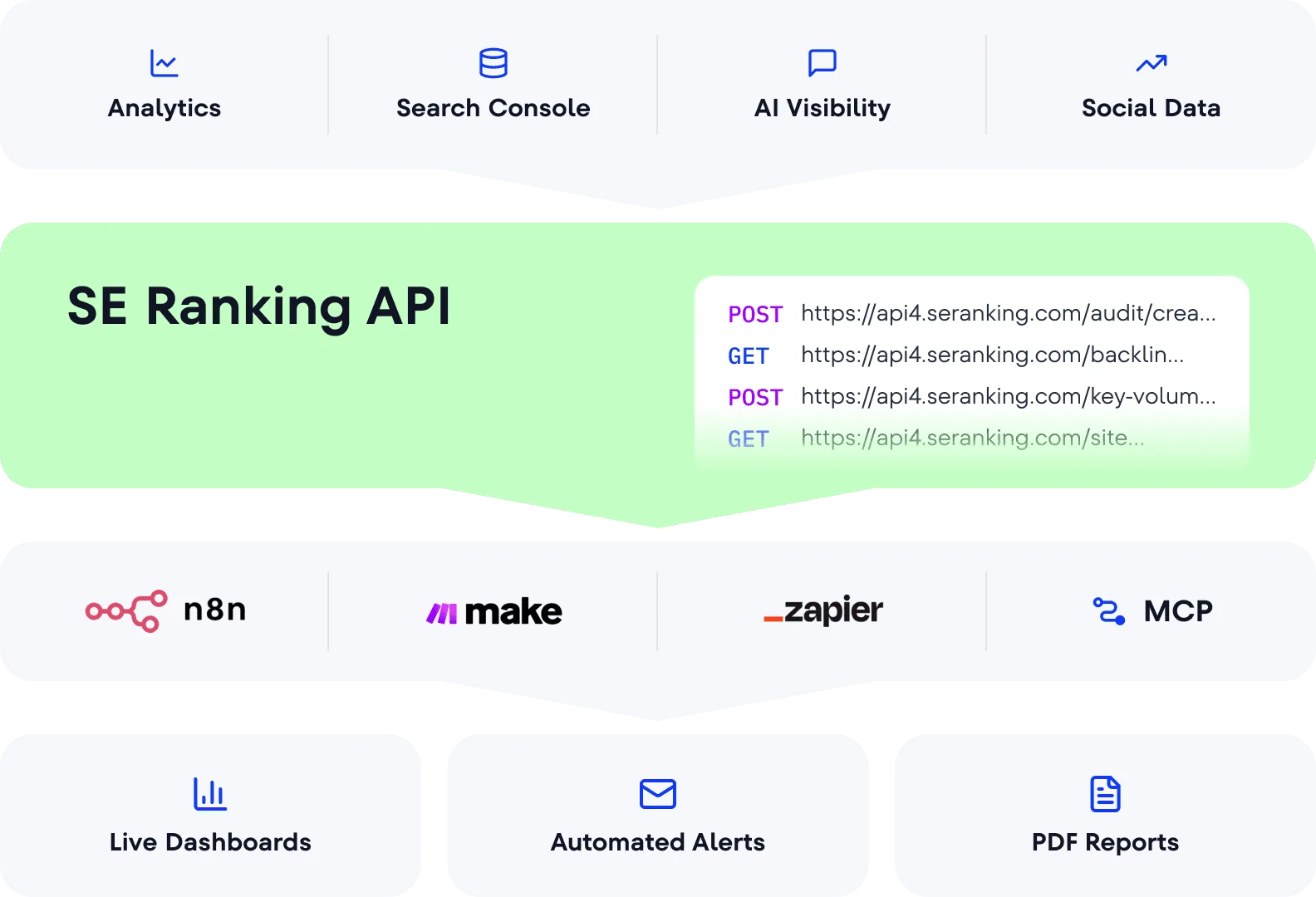
With 180+ specialized tools spanning keyword research, backlink analysis, site audits, SERP tracking, and AI search visibility, SE Ranking covers every major SEO task in a single connection. It's the only platform that bridges traditional technical SEO with AI visibility tracking. The MCP server for SEO includes semantic keyword clustering, competitor gap analysis, domain traffic insights, and page-level metrics.
Core capabilities:
- Keyword research and competitive analysis
- Backlink analysis with link quality scoring
- Domain traffic and ranking intelligence
- Technical website audits (500k+ page crawls per month)
- Project and rank tracking management
- AI Search share of voice tracking
- Ready-to-use SEO prompt templates for common analysis tasks
Published SE Ranking pricing starts at $103.20/month (billed annually at $129 monthly). The Core plan covers 10 projects, 2,000 daily keyword positions, 100 GEO prompts per day, 250k audit pages, and 25K Research API credits with MCP access included.
Growth tier sits at $223.20/month annual ($279 monthly), offering 30 projects, 5,000 daily positions, all-time historical data, and 100K API credits. An Agency Pack add-on ($69/month annual) unlocks white-label reporting.
You can also start with a $50 minimum deposit to get access to API or MCP. A 14-day free trial with 100,000 credits requires no credit card.
Best For
- Agencies needing complete SEO coverage without managing multiple integrations.
- In-house SEO teams conducting daily keyword and backlink monitoring.
- Consultants who require client reporting built into the workflow.
Pros
- Officially maintained MCP, with SE Ranking tracking product updates actively
- Largest tool count among competitors
- Agency-ready with pre-built workflows and white-label reports
- MIT license makes it accessible for most use cases
- One connection handles keyword, backlink, audit, and tracking tasks
- Setup is straightforward for non-technical users
- Pricing is roughly half that of Semrush or Ahrefs at comparable feature depth
Cons
- No real-time rank tracking, daily updates only
- API rate limits kick in at high query volumes
DataForSEO: MCP Server for SERP Data
DataForSEO leads on cost efficiency for custom workflows. The open-source TypeScript server exposes modular tools: SERP, Keywords, Backlinks, On-page, Domain Analytics, Content Analysis, Business Data, AI Optimization, and DataForSEO Labs. Teams enable only the API families they need, reducing cost exposure and attack surface simultaneously. If your comparison includes extraction vendors, pair this with the Web Scraping API: How to Choose One in 2026 guide.
Modular capabilities:
- Multi-engine SERP analysis covering Google, Bing, Yahoo, and DuckDuckGo
- Keyword discovery and search volume data
- Backlink indexes with anchor text and quality metrics
- On-page audit and technical SEO analysis
- Domain analytics and competitor intelligence
- LLM Scraper (collects AI model responses at scale)
- LLM Mentions API (tracks brand mentions across LLMs)
- Open-source TypeScript deployment via Docker or Cloudflare Workers
DataForSEO runs on pure pay-as-you-go API credits with no subscription minimum. A $50 minimum deposit is required, with $1 free trial credit on registration. SERP pricing runs roughly $0.0006 per first-page query ($0.00045 at 25% volume discount). At very high volumes, DataForSEO costs 60-70% less than Semrush or Ahrefs subscriptions. The tradeoff: no pre-built agency features or managed UI.
Best For
- SaaS companies building SEO tools or dashboards.
- Development teams needing cost control at scale.
- Agencies with technical resources to manage custom integrations.
Pros
- Lowest cost at high query volumes
- Fully modular, so you only pay for API families you use
- Open-source deployment options (Docker, Workers)
- Comprehensive SERP coverage across multiple engines
- LLM Mentions and LLM Scraper APIs unique to the market
- No subscription bloat, strictly pay-as-you-go
- Ideal for building white-label SEO tools
- Technical teams can monitor and optimize spend per request type
Cons
- No pre-built workflows or agency features
- Requires developer setup and ongoing management
- Per-query billing demands monitoring to avoid surprise costs
- No UI, results return as raw JSON
- Steeper learning curve than packaged competitors
Google Analytics: MCP Server for GA4 Data
Google Analytics 4 connects conversion and behavior data directly to your AI assistant. The MCP server lets Claude or Gemini query dimensions and metrics, run historical reports, and retrieve real-time user activity without opening the GA4 dashboard.
Key capabilities:
- Run flexible GA4 reports with customizable dimensions, metrics, date ranges
- Retrieve real-time analytics for immediate operational insights
- Account management for summaries of all accessible properties
- Retrieve and query property annotations
- Traffic source performance analysis
- Conversion rate and attribution data
- Custom segment filtering
- Historical and segmented data comparison
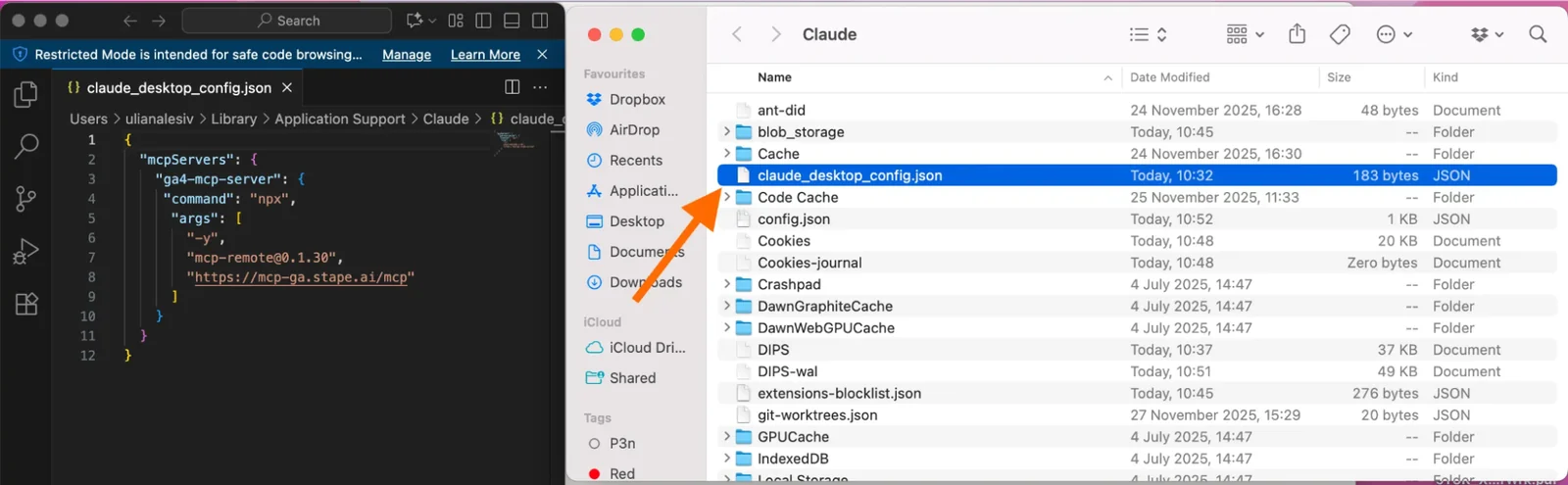
Two implementations exist. Google's official experimental server runs free via pipx on Python 3.10+. Stape's commercial version ($0 to $9/month depending on usage) handles OAuth setup and hosted remote access if you want zero local configuration.
Best For
- Marketing teams needing GA4 insights without dashboard context-switching.
- Conversion-focused analysis inside AI workflows.
- Teams combining traffic data with SEO rank tracking.
Pros
- Official Google implementation (experimental) is completely free
- Stape's remote version offers one-click OAuth authentication
- Covers the full GA4 reporting API
- Natural language queries against complex analytics data
- Real-time data access eliminates report lag
- Integrates with SE Ranking or Ahrefs for cross-data analysis
- Works with Claude, Gemini, and ChatGPT
- No API costs, only platform fees if using commercial versions
Cons
- Official version requires local Python setup
- Limited to read-only queries, so it cannot edit GA4 configuration
- Requires Application Default Credentials setup (technical overhead)
- Some implementations experimental status means occasional breaking changes
- Not SEO-specific, requires manual filtering to isolate organic traffic
Nightwatch: MCP Server for Rank Tracking
Nightwatch MCP is built for enterprise teams that prioritize rank tracking precision and AI visibility monitoring. The official server exposes rank tracking, AI visibility, keyword research, site audits, and reporting directly into Claude, Cursor, or ChatGPT. It does one thing exceptionally: rank tracking with precision and intelligence.
If AI search reporting is the main reason you are evaluating MCP servers, compare this section with Best API for AI Visibility 2026: Top Tools to Choose From.
Core tools:
- Live rank tracking with geo and device segmentation
- AI visibility monitoring (Perplexity, Claude, other LLMs)
- Site audit and technical SEO analysis
- Keyword research and competitor analysis
- Custom report generation
- Local SEO tracking across geographies
- Internal linking suggestions based on rankings
- Content freshness monitoring
Nightwatch operates on a subscription model (exact pricing varies by plan), with official MCP access included on all paid tiers. The focus is precision, not budget. Enterprise plans available on request.
Best For
- Enterprise SEO teams managing multiple client accounts.
- Agencies prioritizing rank tracking accuracy over tool breadth.
- Teams running AI visibility strategies for SERM and AEO.
Pros
- Most accurate rank tracking in the market, geo-specific and device-aware
- Official MCP server, consistently maintained
- AI visibility monitoring native to platform (not bolt-on)
- Real-time data access for immediate issue detection
- Excellent for detecting ranking shifts before traffic drops
- Content freshness alerts prevent indexing surprises
- Internal linking recommendations automated
- White-label reporting built in
Cons
- Higher cost than niche rank-tracking tools
- Limited to rank tracking, audits, and AI visibility
- No keyword research breadth, focused on tracked terms
- Enterprise positioning means smaller-team pricing may not fit
- Requires Nightwatch account (not free tier available)
Google Search Console: MCP Server (MCP-gsc)
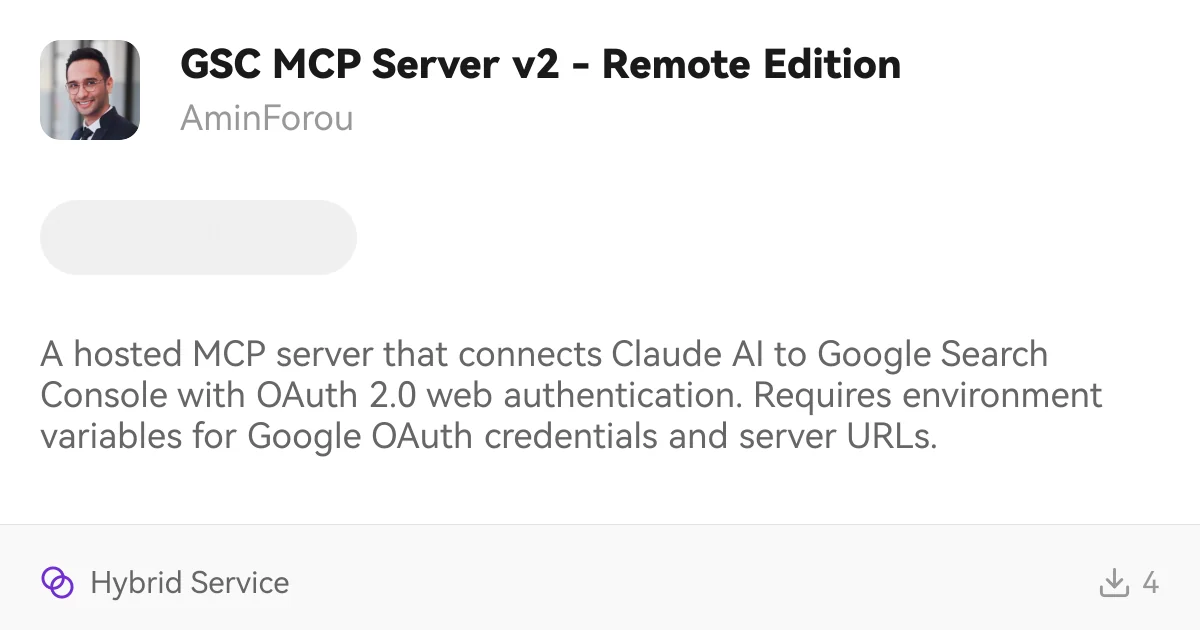
Built by developer AminForou, MCP-gsc is the most popular open-source SEO MCP server. It connects Google Search Console directly to Claude AI with 20 tools covering search analytics, URL inspection, and sitemap management. For owned-property performance data, this is the correct starting point. It's free, it's open-source, and it's battle-tested.
Available tools:
- Search analytics (clicks, impressions, CTR, position data)
- URL inspection for indexing issues and crawlability
- Sitemap submission and management
- Property listing and permission level retrieval
- Search performance filtering by query, page, device, country
- Keyword cannibalization detection
- "Almost ranking" opportunity identification (positions 8–15)
- Advanced GSC Visualizer Chrome extension (14,000+ users)
Completely free. Open-source under Apache license. Optional Advanced GSC Visualizer Chrome extension costs $12/month during founding cohort for hosted MCP access (removes local setup requirement).
Best For
- Solo SEO consultants and small teams.
- Anyone needing first-party GSC data without additional costs.
- Teams building SEO workflows without subscriptions.
Pros
- Free and open-source with no licensing costs
- 600+ GitHub stars and active community
- Extremely detailed documentation
- Works with Claude Desktop, Cursor, Codex CLI, Gemini CLI
- Zero setup complexity option if using hosted Advanced GSC version
- Canonical ranking data from Google
- Detects keyword cannibalization and low-CTR patterns automatically
- OAuth browser flow updated for easier authentication
Cons
- Requires local setup if not using hosted version
- First-party data only, no competitive intelligence
- No keyword research or backlink data
- Limited to GSC's 16-month data window
- Cannot edit GSC configuration (read-only)
SEOptimer: SEO MCP Server
SEOptimer's MCP integration runs full SEO audits on any domain directly inside Claude, returns results instantly, and lets you ask follow-up questions without leaving the AI conversation. For technical audits during client pitches or quick competitive checks, the workflow reduction is measurable. Run an audit, get a report, ask Claude for analysis in one window.
Audit capabilities:
- Full technical SEO audits
- On-page optimization scoring
- Content quality analysis
- Mobile usability assessment
- Performance metrics (Core Web Vitals)
- Accessibility checks
- SSL certificate validation
- Competitive domain audits
- Quick-win recommendations
SEOptimer subscription required. Starter plans include SEO API access and MCP integration on the same API key. All plans include API access, bulk reporting, white-label report generation, and MCP access.
Best For
- Agencies running client pitches and needing quick technical audits.
- Consultants conducting competitive domain checks.
- Teams integrating SEO audits into client onboarding workflows.
Pros
- Extremely fast audit execution (results in seconds)
- Clean, easy setup for non-technical users
- Full website crawl without UI navigation
- White-label reporting built in
- Affordable entry price ($19/month)
- Works across Claude, ChatGPT, and Cursor
- Prompt templates built for common audit questions
- API-based pricing scales with usage
Cons
- Audit-focused only, no keyword research or backlinks
- No AI visibility or AI search monitoring
- No rank tracking or historical data
- Requires SEOptimer subscription (no free tier)
- Limited to web audit use cases
Serpstat: MCP Server for SEO Research
Serpstat MCP covers all standard best SEO MCP server use cases at a lower price point. Semantic clustering and competitor gap analysis make it particularly strong for content strategists. The official server (released February 2026) supports keyword research, domain analysis, backlink research, site audits, rank tracking, and AI Overview monitoring.
Covered capabilities:
- Domain and competitor analysis with visibility metrics
- Keyword research with search volume and difficulty scoring
- Semantic keyword clustering with advanced filtering
- Backlink analysis with referring domain data
- URL and page ranking analysis
- AI Overview monitoring and positioning
- Site audit reports
- Competitor keyword gap analysis
- Historical data for trend analysis
Mid-market pricing. Exact plans vary, but Serpstat positions as 30-40% cheaper than Semrush at comparable feature coverage. Free trial available. All paid tiers include MCP access.
Best For
- In-house SEO teams with mid-range budgets.
- Content strategists focusing on semantic clustering and gap analysis.
- Agencies wanting full-stack coverage without enterprise pricing.
Pros
- Strong semantic clustering algorithm (better than most competitors)
- Competitor gap analysis particularly robust
- Lower price than Semrush or Ahrefs at comparable features
- Supports Claude, Gemini CLI, ChatGPT, and others
- Official MCP released and actively maintained
- Clean UI makes non-technical team members comfortable
- Good balance of breadth and depth
Cons
- Smaller dataset than Ahrefs (fewer historical backlinks)
- Less backlink depth for highly competitive niches
- Less brand recognition among enterprise teams
- User base smaller than SE Ranking or Ahrefs (fewer public case studies)
Ahrefs: MCP Server for Backlink Research
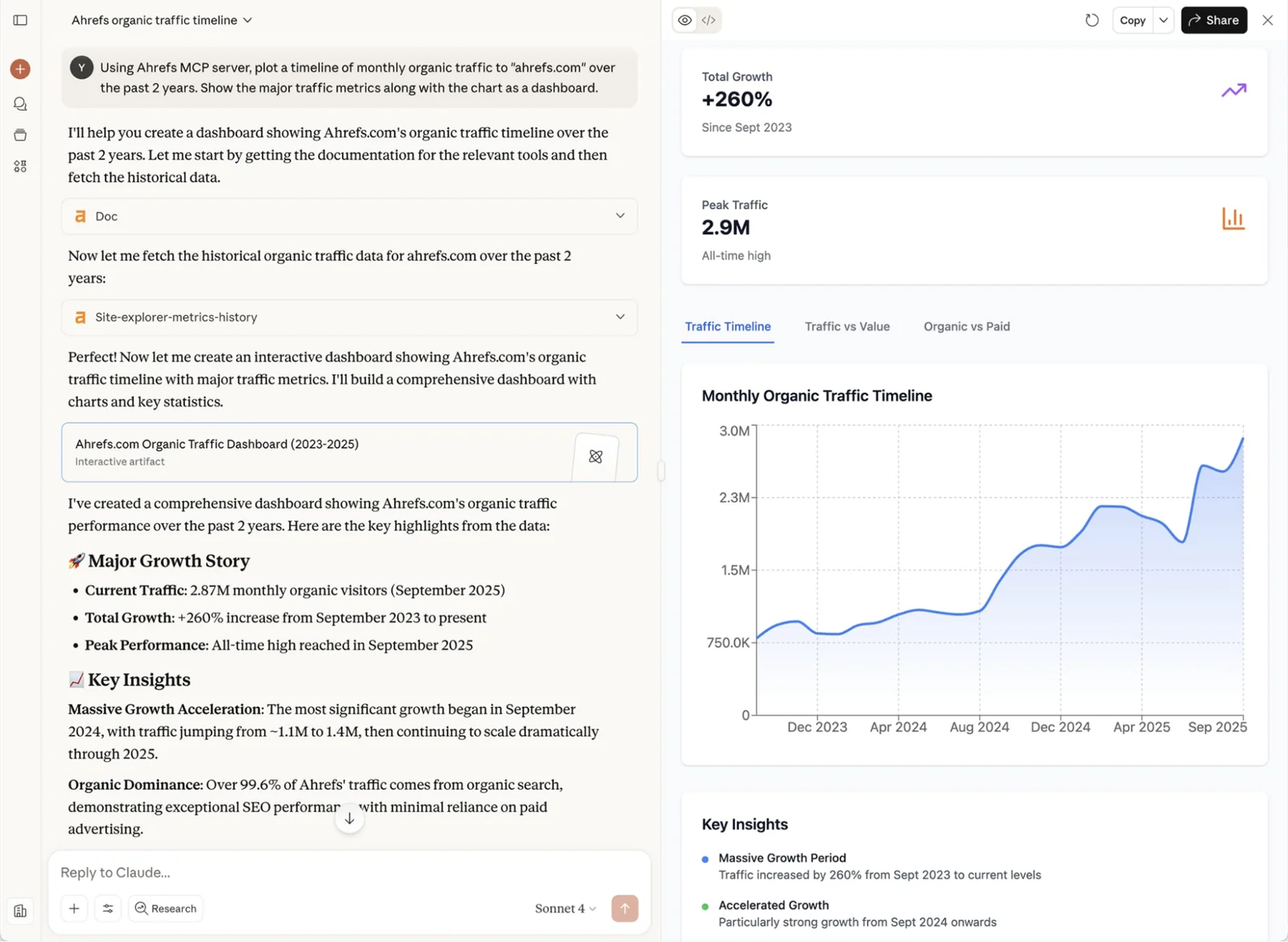
Ahrefs leads on link data depth. The official remote MCP server connects directly to your Ahrefs account with tools for rank tracking, keyword research, competitor analysis, and backlink profiles. It's strong for backlink-heavy research, ideal for link-building workflows and competitive intelligence focused on link strategy.
Specialized tools:
- Rank tracking and keyword research capabilities
- Competitor analysis with backlink profiles
- Backlink database access (largest indexes updated weekly)
- SERP feature scraping ("Popular products," "People also search for" by location)
- Domain rating and authority scoring
- Anchor text analysis
- Competing domain identification by keyword overlap
- Link quality assessment
Requires paid Ahrefs API plan. API access adds to base subscription costs. Enterprise plans available on request. MCP access included on most tier-ups.
Best For
- Link-building agencies and teams focused on backlink research.
- Competitive intelligence workflows.
- Teams with existing Ahrefs subscriptions.
- Any team where backlink analysis drives SEO strategy.
Pros
- Largest backlink index on the market with comprehensive data
- Official Ahrefs MCP, consistently updated with platform changes
- Exceptional for discovering link-building opportunities
- Anchor text analysis is industry-leading
- SERP feature data unique to the platform
- Works across Claude, ChatGPT, Microsoft Copilot Studio, and others
- Integrates well with existing Ahrefs workflows
- Remote server access, no local setup required
Cons
- Higher pricing entry point
- Backlink-focused, not a comprehensive SEO MCP
- No on-page audit capabilities
- No GA4 or analytics integration
- Overkill for teams only needing keyword research
Semrush: MCP Server for Competitive Intelligence
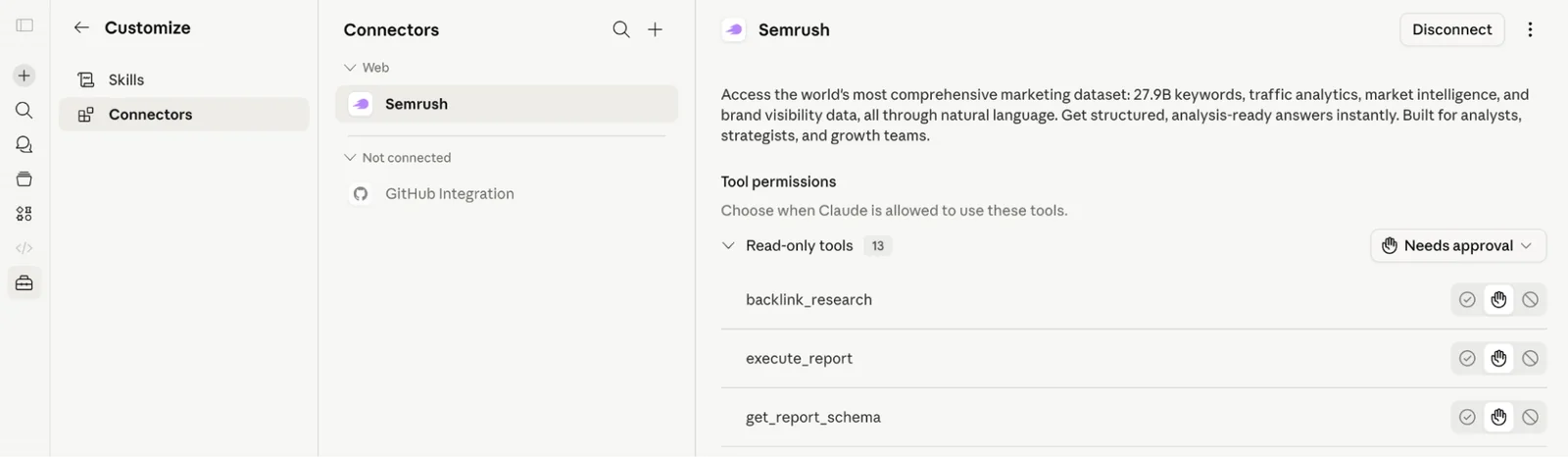
Semrush leads on competitive intelligence at scale. The official MCP server covers two data surfaces: the Trends API (market analysis, traffic estimates, audience demographics, competitive benchmarking) and the Standard API (keyword data, backlink profiles, domain analytics). That dual coverage makes it more of a competitive intelligence tool than a pure SEO server. Enterprise SEO and competitive intelligence teams find this combination unmatched.
Dual API coverage:
- Trends API: traffic estimates, audience overlap, growth benchmarks, domain demographics
- Standard API: keyword research data, backlink profiles, domain analytics
- Keyword difficulty scoring and search volume
- Rank tracking and position history
- Competitive domain analysis
- PPC intelligence and ad copy analysis
- Market research and industry benchmarking
- Multi-channel competitive analysis (SEO + PPC overlap)
Semrush MCP requires an active plan. MCP access depends on plan and API availability. Unit-based system manages API consumption (each query type costs different units). For enterprise teams, custom packages are available.
Best For
- Enterprise SEO teams needing multi-channel competitive intelligence.
- Large agencies conducting market research alongside SEO.
- Teams analyzing paid + organic overlap.
- Marketing departments requiring audience demographic data.
Pros
- Dual API coverage unique to market (Trends + Standard)
- Strongest competitive intelligence breadth
- Audience demographic data (uncommon in SEO tools)
- Enterprise-scale data accuracy
- PPC intelligence helps identify channel gaps
- Multi-language support for global campaigns
- Official MCP, actively maintained by Semrush engineering
- Works across Claude, ChatGPT, Cursor, VS Code
Cons
- Highest total cost of ownership for most teams
- Requires multiple subscriptions (base + API)
- MCP access gated to higher tiers
- Overkill for small-to-mid teams
- UI complexity steeper than simpler competitors
Coupler.io: MCP Server for Business Data
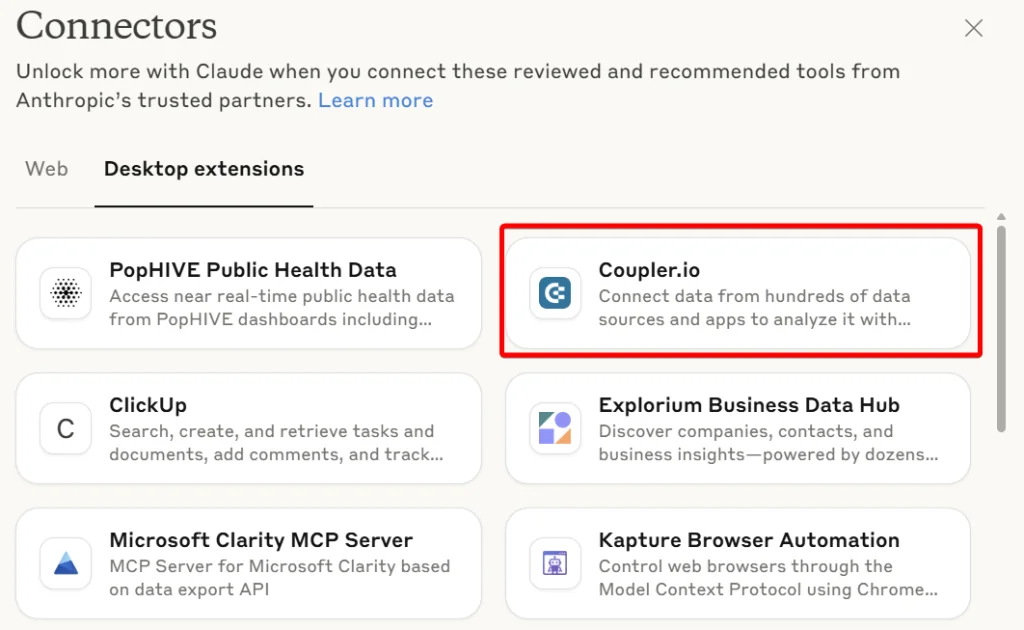
Coupler.io acts as a universal bridge to 400+ business data sources. The MCP server connects over 400 business apps, including Google Search Console, Google Business Profile, Google Analytics, ad platforms, CRMs, and accounting software, into one centralized database. Its MCP server exposes these datasets directly to AI assistants so you can query them in plain language without SQL.
Integration scope:
- 400+ business app connectors
- Google Search Console, GA4, Google Business Profile native support
- Ad platform data (Google Ads, Meta Ads, others)
- CRM data (HubSpot, Salesforce, and others)
- E-commerce platforms (Shopify, WooCommerce, and others)
- One-click sign-in via OAuth or API key
- SQLite query engine for instant analysis
- Data flow creation and management via MCP
- Cross-source analysis without manual exports
A free tier is available, and paid plans scale with data volume. MCP access is included at no additional cost above the Coupler.io subscription. No separate MCP fees.
Best For
- Marketing teams pulling SEO data alongside paid media, CRM, and financial data.
- Agencies building custom AI agents that need multi-source data access.
- Teams tired of exporting CSVs from 10 different tools.
- Anyone needing "single source of truth" for AI analysis.
Pros
- Connects 400+ sources and covers almost every business tool
- No-code setup with no SQL or coding required
- One MCP instead of dozens of separate integrations
- Excellent documentation and community support
- Free tier lets you test before paying
- Context editor helps AI understand your data structure
- Skill-based automation tells AI when to trigger workflows
- Docker deployment for advanced users
Cons
- Broadest rather than deepest, not specialized for SEO
- Requires Coupler.io account setup (one more platform)
- Data freshness depends on sync schedule (not real-time)
- Some edge cases require custom SQL knowledge
- Smaller audience means fewer public case studies
FAQ
What's the difference between an SEO MCP server and an SEO API?
An API requires custom code. You write code to make API calls, handle errors, and format results. An MCP server is pre-built. You connect once and ask Claude a question. The MCP server for SEO translates your question into API calls automatically. No coding required. MCP also handles authentication securely, manages pagination, and returns data formatted for AI analysis. For SEO teams, MCP cuts the time between question and answer from hours (with APIs) to seconds.
Can I run multiple MCP servers simultaneously?
Yes. Most teams run two or three MCP servers at once. A common setup: SE Ranking (keyword and backlink data) + DataForSEO (live SERP scraping) + MCP-gsc (first-party GSC data).
Do MCP servers work with ChatGPT, or only Claude?
MCP is an open standard. Most servers support Claude, ChatGPT, Cursor, VS Code, Gemini CLI, and Microsoft Copilot Studio. SE Ranking, Ahrefs, Semrush, Serpstat, and Nightwatch explicitly support ChatGPT. DataForSEO works across multiple clients.
Conclusion
Choosing the right best MCP server for SEO depends on what data you're pulling, how technical your setup is, and what you already pay for:
- Tool count and breadth: SE Ranking.
- Link data depth: Ahrefs.
- Competitive intelligence at scale: Semrush.
- Cost efficiency for custom workflows: DataForSEO.
- Mid-market coverage: Serpstat.
- First-party Google data: MCP-gsc.
All 10 are production-ready MCP server SEO options. Pick one based on where your biggest data gaps are today, then add a second connection once your agentic workflow is stable.