


TL;DR
For most agencies and SaaS teams, SE Ranking is the best API for AI visibility because it combines LLM mention tracking, Google AI Overview monitoring, reporting, and traditional SEO data in one stack. Profound fits enterprise brand teams, DataForSEO fits custom data products, Ahrefs works for teams focused on Google AI Overviews, and Writesonic GEO suits content teams that want optimization guidance with visibility checks.
If you're building client dashboards, reporting pipelines, or an internal readout on AI search, plain rank tracking isn't enough anymore. You need data you can pull: where your brand shows up, which pages get cited, and how often ChatGPT, Perplexity, Gemini, Copilot, or Google AI Overviews choose you instead of a competitor.
The shortlist is pretty clean once you separate platforms from raw data vendors:
- SE Ranking: the strongest all-around pick for agencies and SaaS teams that need API data, dashboards, and white-label output in one stack
- Profound: built for enterprise brand monitoring where AI share of voice is its own budget line
- DataForSEO: raw SERP and SEO infrastructure for teams that would rather build the product layer themselves
- Ahrefs: useful if your team already lives in Ahrefs and mostly cares about Google AI Overview data
- Writesonic GEO: a content-led option for teams that want recommendations attached to visibility checks
What Is the Best API for AI Visibility?
For most teams, SE Ranking is the safest first choice because it doesn't force a trade between old-school SEO data and AI search reporting. You can track brand and keyword mentions across LLM platforms, pull the data into client reports, and keep rank tracking, audits, and backlink research in the same account.
For example, you can track brands, keywords and mentions across various LLMs platform such as ChatGPT, Google Gemini, Perplexity and others. You’ll get full API access for reporting, dashboards, integrations and it is dead simple to wire it up to you agentic workflow.
In a nutshell:
- Tracks AI Overview presence and LLM citations in a single dashboard
- Exposes data via a clean REST API suitable for agency reporting or SaaS product builds
- Covers traditional SEO + AI visibility in one platform, which cuts tool costs
- Pricing is competitive against specialist tools that do less
- The AI search visibility API for reporting use case is first-class, not an afterthought
For teams already using SE Ranking for rank tracking or site audits, the AI layer is a practical add-on rather than another vendor to onboard.
Comparison Table of
| Tool | AI Mention Tracking | LLM Coverage | API Access | White-Label | Best For | Starting Price |
|---|---|---|---|---|---|---|
| SE Ranking | Yes | ChatGPT, Gemini, Perplexity, Copilot | Full REST API | Yes | Agencies, SaaS, Reporting | Pay-as-you-go starting at $50/mo |
| Profound | Yes | Multiple LLMs | Enterprise API | No | Enterprise brand monitoring | Custom |
| DataForSEO | Partial (SERP AI data) | Google AI Overviews | Full REST API | No | Developers, data resellers | Pay-as-you-go |
| Ahrefs | Limited | Google AI Overviews | API (higher tiers) | No | Existing Ahrefs users | $129/mo |
| Writesonic GEO | Yes | ChatGPT, Perplexity, others | Limited | No | Content teams, small agencies | $99/mo |
SE Ranking
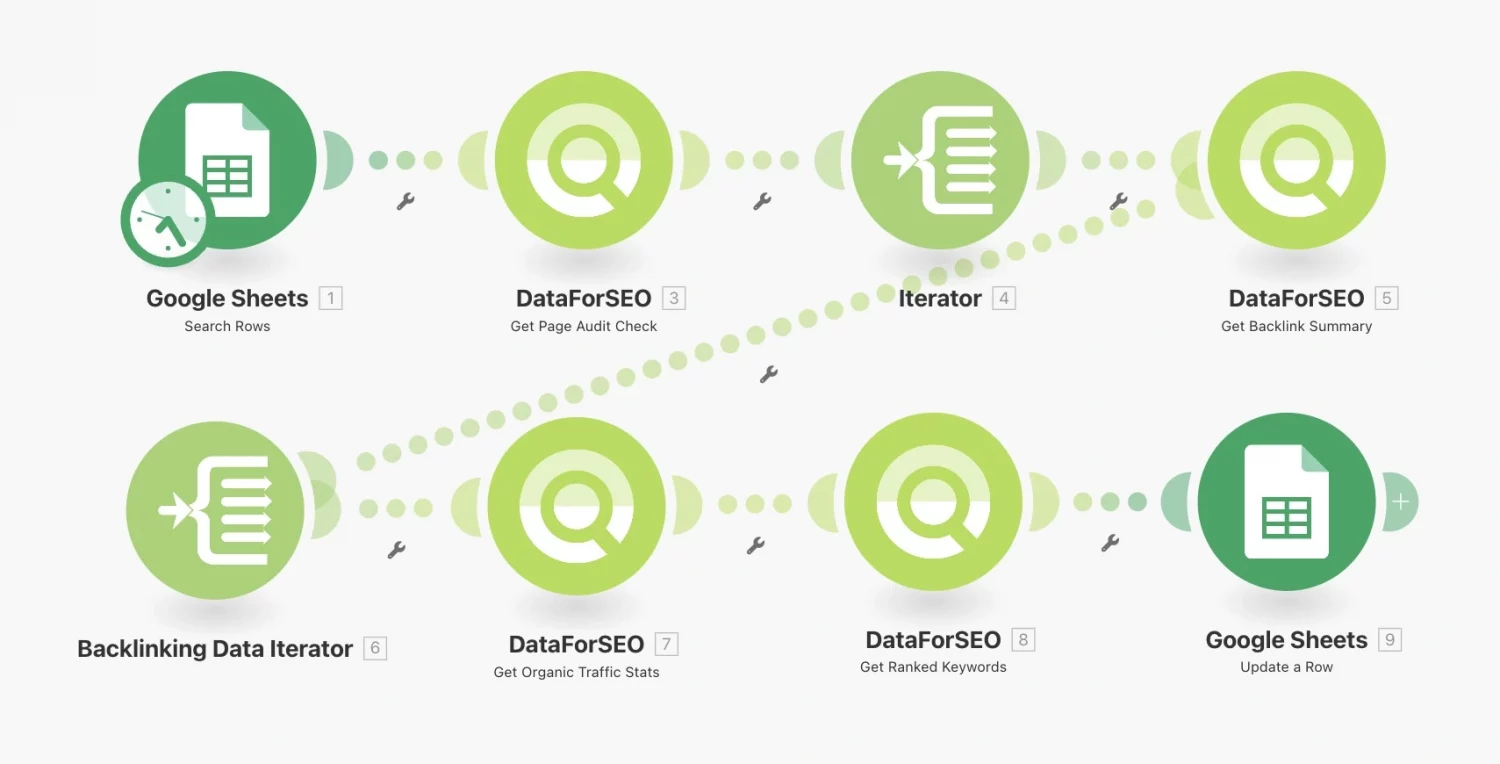
SE Ranking is an SEO platform that moved into AI visibility once LLM search started showing up in real reporting. The appeal is simple: agencies can keep rank tracking, audits, backlinks, AI mentions, and client exports under one roof.
What SE Ranking Gives You
- Tracks brand and keyword citations across ChatGPT, Google Gemini, Perplexity, and Microsoft Copilot
- Monitors AI Overview presence in Google SERPs at scale
- REST API endpoints for AI visibility data, rank tracking, site audit, and backlink analysis
- White-label reports suitable for client delivery
- Competitor AI mention benchmarking; see which brands appear alongside yours in LLM outputs
- Scheduled automated queries to LLMs for consistent longitudinal tracking
- Custom dashboards with exportable data
SE Ranking Pros and Cons
Pros:
- One platform covers both traditional SEO and AI visibility, with fewer integrations to manage
- API is well-documented and production-ready, not a beta feature
- White-label capability makes it deployable in agency workflows
- Transparent pricing with clear tier limits
- Active product development; new LLM platforms get added as they grow
Cons:
- Breadth of features means some depth trade-offs versus specialist tools
- API rate limits on lower plans can constrain high-volume data pulls
- LLM coverage is still expanding; some newer platforms lack full tracking
Pricing
- Core Plan ($129/month or $103.20 billed annually): 10 projects & 1 seat, 2,000 keywords + 100 prompts daily, 5 GEO domains, 250k audit pages/month, 25k API credits with MCP access, rank tracking, unlimited keyword/backlink research, site audit, and integrations (GA, GSC, Looker Studio, Matomo)
- Growth Plan ($279/month or $223.20 billed annually): 30 projects & 3 seats, 5,000 keywords + 250 prompts daily, 15 GEO domains, 2M audit pages/month, 100k API credits with MCP access, all Core features plus historical data, collaboration tools, page monitoring, and dedicated support
- Agency Pack (+$69/month, annual): add-on with 30 projects, 30 client seats, full white-label platform & reports, unlimited scheduled reports with AI summaries, agency catalog placement, and lead generator
- AI Search Add-on ($89/month or $71.20 annually): 200 prompts, tracking across AI platforms (ChatGPT, Perplexity, AI Overviews), unlimited competitor research, SE Visible dashboard, and automated reporting
- API Add-on ($149/month, annual): 12M credits, access to backlinks, domain analysis, keyword research, AI search, and website audit APIs for automation
- SMM Platform (from $33/month): social media scheduling, collaboration workflows, content planning, analytics, and asset management
- SEO Data API (from $179/month): standalone API with scalable volume, access to backlinks, domains, AI search queries, MCP integration, and automation via tools like Looker Studio, n8n, and Make
- 24M Credits Plan ($318/month effective): 24M credits/year (billed $3,816/year upfront), suitable for large-scale API usage and automation workflows
Best Use Cases
- Agencies building client AI visibility reports on a recurring basis
- SaaS companies monitoring their brand's LLM citation share against competitors
- E-commerce teams tracking product category mentions in AI shopping queries
- IT and outsourcing firms reporting AI search performance to stakeholders
- Any team that needs AI search data feeding a BI dashboard
Profound
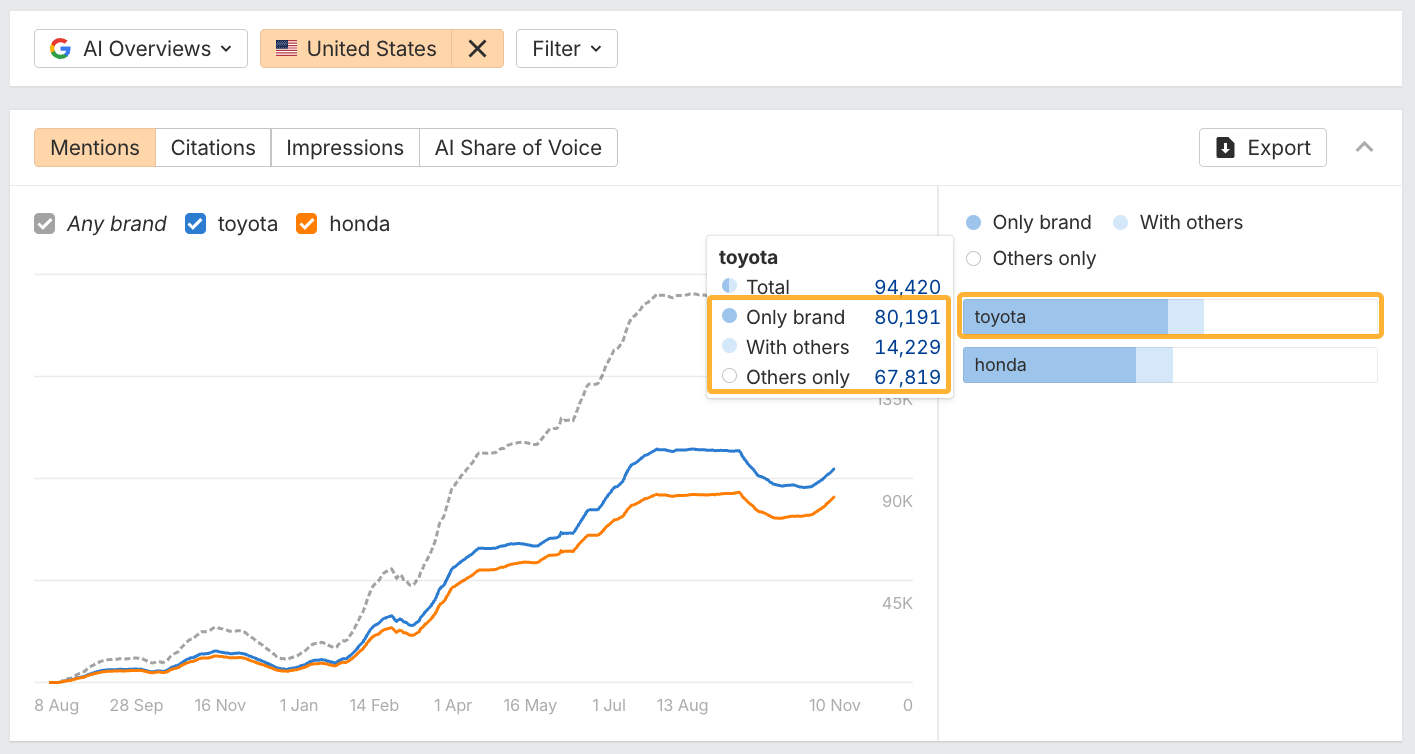
Profound is built for enterprise AI visibility monitoring. It focuses on how brands appear in LLM-generated answers at scale, which makes it a better fit for large companies with multiple products, markets, or brand teams than for a small agency stack.
Key Features
- Real-time monitoring of brand mentions across major LLMs
- Attribution tracking that identifies which sources LLMs cite when mentioning your brand
- Share-of-voice metrics across LLM platforms over time
- API access designed for enterprise data pipelines and BI tool integration
- Alert system for unexpected brand mention changes
- Competitor tracking with side-by-side LLM visibility comparisons
- Segment tracking by product line, geography, or topic cluster
Profound Pros and Cons
Pros:
- Built specifically for the enterprise AI visibility problem, not a feature bolted onto an SEO tool
- Source attribution is genuinely useful for content strategy (know which pages get cited)
- API design is robust enough for high-volume enterprise data workflows
- Strong support and onboarding for large accounts
Cons:
- No public pricing, so you need a sales conversation before you can evaluate cost
- Overkill for small agencies or solo practitioners
- Lacks traditional SEO features; needs to run alongside a separate rank tracker
- Minimum contract size makes it inaccessible for smaller teams
Pricing
- Starter Plan ($99/month): ChatGPT tracking only, 50 prompts tracked, email support, designed for small companies monitoring brand visibility
- Growth Plan ($399/month): 3 answer engines tracked, 100 prompts tracked, 6 optimized articles per month, email support, built for growing companies focusing on AEO content
- Enterprise Plan (custom pricing): up to 10 answer engines tracked, multi-company tracking, tailored prompt plans, dedicated Slack support, and SSO/SAML + SOC2 compliance for large-scale operations
Best Use Cases
- Global brands monitoring AI citation share across multiple product lines
- Enterprise marketing teams that need LLM visibility monitoring SaaS with API access integrated into Salesforce, Tableau, or similar systems
- PR and communications teams tracking brand narrative in AI-generated content
- Large e-commerce retailers monitoring category-level AI visibility
- Organizations where a dedicated budget for AI search intelligence is already established
DataForSEO
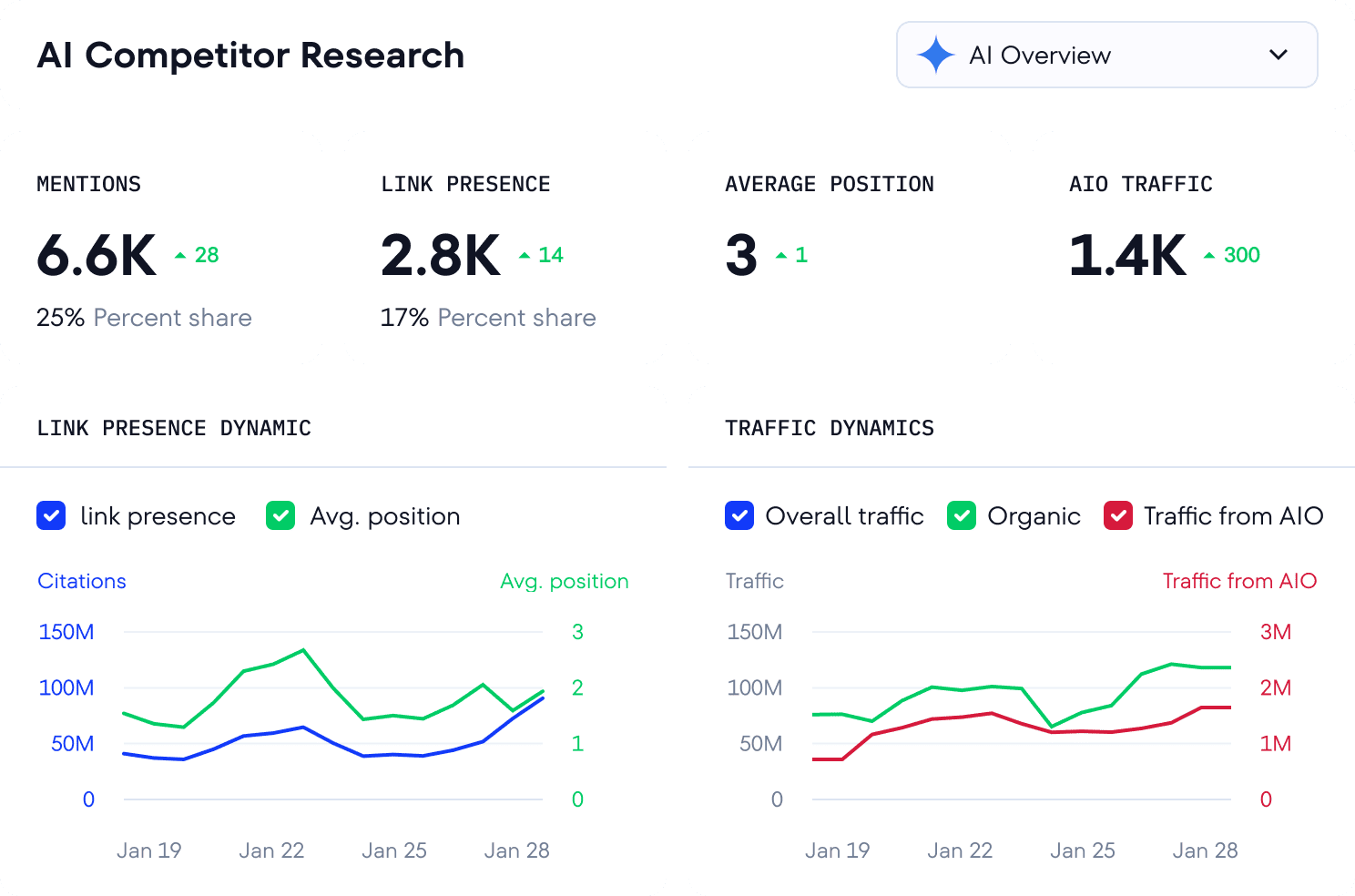
DataForSEO is not really a visibility platform. It's raw SEO infrastructure. Its SERP API can return Google AI Overview content programmatically, which makes it useful when you're building your own monitoring layer and don't want a vendor's dashboard.
Key Features
- SERP API returns full Google results including AI Overview content
- Real-time and on-demand data pulls across 50,000+ locations and language combinations
- Rank tracking API, backlink API, keyword data API, and the full SEO data stack
- DataForSEO Labs API for keyword research and search volume
- Webhook support for async large-scale jobs
- Response caching and batch processing for cost efficiency
- No monthly seat fees, just pay-as-you-go billing
DataForSEO Pros and Cons
Pros:
- The most flexible data infrastructure option for developers building custom tools
- Granular geographic and language targeting for international SEO reporting
- Pay-as-you-go means cost scales with actual usage, not with seat count
- Well-maintained documentation and active developer community
- Can serve as the data backbone for a fully custom AI search visibility API for reporting build
Cons:
- Not a plug-and-play visibility platform, so it requires significant development work
- AI Overview data is Google-only; no LLM mention tracking (ChatGPT, Perplexity, etc.)
- No UI, so data engineers or developers must build dashboards themselves
- Managing API costs requires discipline; unconstrained usage can get expensive
Pricing
- Pay-as-you-go: pricing per 1,000 API tasks, varying by endpoint
- SERP API: from roughly $0.60 per 1,000 tasks at basic tiers
- Prepaid credits with volume discounts available
- No minimum commitment required
Best Use Cases
- Agencies building proprietary SEO reporting tools for clients
- SaaS companies that need raw search data embedded in their products
- Data engineers building custom API for LLM visibility pipelines where Google AI Overviews are the focus
- Teams that need highly localized SERP data at scale
- Developers who want full control over data processing and storage
Ahrefs
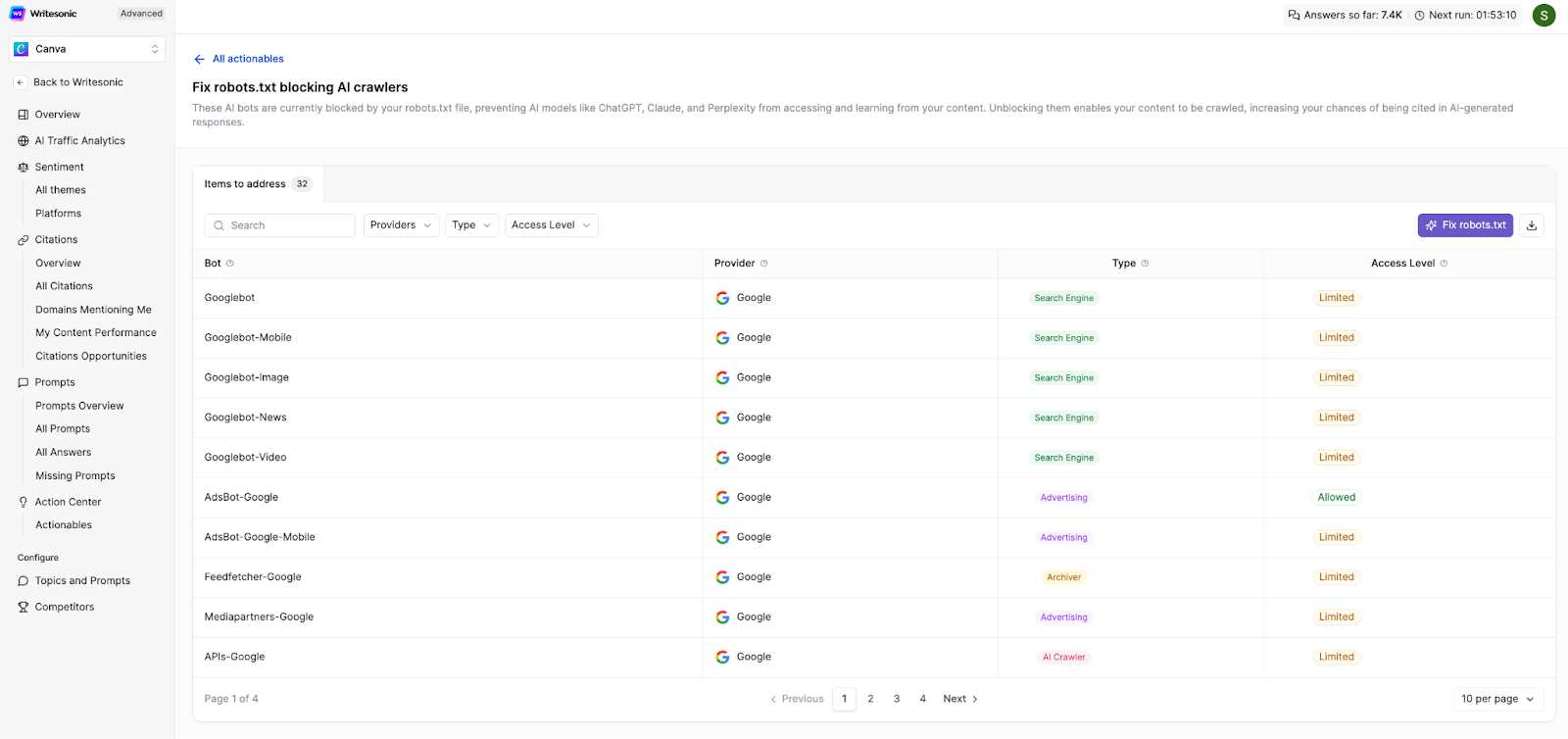
Ahrefs is still mainly an SEO platform. Its AI angle comes through SERP analysis and AI Overview tracking, not broad LLM citation monitoring. If your team already pays for Ahrefs, it can add Google AI Overview data without another login, but it won't replace a dedicated multi-LLM monitor.
Key Features
- AI Overview tracking within Ahrefs' rank tracker
- SERP feature analysis that includes AI Overview presence per keyword
- Backlink analysis, keyword research, and site audit in the same platform
- API access for rank data, keyword data, and backlinks (higher plans)
- Alerts for ranking changes including AI Overview appearances
- Content gap analysis tools with AI feature context
- Historical SERP data for trend analysis
Ahrefs Pros and Cons
Pros:
- Teams already paying for Ahrefs get AI Overview data without switching tools
- Best-in-class backlink data is a genuine competitive advantage for link-focused SEO
- Historical data depth is strong for trend analysis
- Interface is familiar and well-documented for existing users
Cons:
- AI visibility features are relatively new and thinner than specialist tools
- API access requires Enterprise plan, a significant cost jump from standard tiers
- No LLM citation tracking for ChatGPT or Perplexity, only Google AI Overviews
- Not built around the LLM visibility API use case; feels like a secondary feature
- Limited white-label capability for agency reporting
Pricing
- Lite Plan ($129/month): 5 projects, 6 months historical data, 750 tracked keywords, 5 tracked prompts, 100k crawl credits, 1,000 credits per user, 1 user (+2 at $40/mo), core tools (Site Explorer, Keywords Explorer, Rank Tracker, Site Audit, Competitive Analysis, API & MCP access, reports, dashboards)
- Standard Plan ($249/month): 20 projects, 2 years historical data, 2,000 tracked keywords, 10 tracked prompts, 500k crawl credits, unlimited credits per user, 1 user (+5 at $60/mo), all Lite features plus Content Explorer, batch analysis, SERP comparison, keyword clusters, AI suggestions, deeper analytics & reporting
- Advanced Plan ($449/month): 50 projects, 5 years historical data, 5,000 tracked keywords, 20 tracked prompts, 1.5M crawl credits, unlimited credits per user, 1 user (+10 at $80/mo), all Standard features plus Looker Studio integration, advanced site audit options, segmentation, and extended data insights
- Enterprise Plan ($1,499/month): all Advanced features plus unlimited API access, SSO & enterprise-grade security, access management & audit logs, unlimited historical data, custom limits & exports, and forecasting & trend analysis (annual commitment required)
Best Use Cases
- Teams deeply invested in the Ahrefs ecosystem who want to avoid tool fragmentation
- Link-heavy campaigns where backlink data is the primary need alongside AI Overview tracking
- In-house SEO teams at mid-to-large companies already on Advanced or Enterprise plans
- Analysts who want Google AI Overview data layered into standard keyword reporting
Writesonic (GEO)
Writesonic added a Generative Engine Optimization module to its writing platform. It checks how brands and pages appear in AI-generated answers, then ties that back to content recommendations. That makes it a content workflow tool first and a visibility API second.
Key Features
- Brand mention tracking across ChatGPT, Perplexity, and other LLM search platforms
- Content optimization recommendations to improve LLM citation likelihood
- Competitor tracking for AI mention share
- GEO scoring system that rates content for AI search readiness
- Integration with Writesonic's content generation tools
- Basic API access for pulling visibility data into external systems
- Keyword tracking with AI citation context
Writesonic GEO Pros and Cons
Pros:
- Natural fit for teams already using Writesonic for content production
- GEO recommendations are actionable because they tell you what to change, not just what is wrong
- More affordable entry point than enterprise-focused tools
- Combines content creation and visibility measurement in one workflow
Cons:
- API is more limited than purpose-built visibility platforms
- Reporting depth is lower than SE Ranking or Profound for agency use cases
- Platform is content-generation-first; visibility tracking is a secondary module
- Not suitable as an enterprise AI visibility and tracking API given current data depth
- Less granular competitor data than dedicated tools
Pricing
- Starter Plan ($99/month): AI search tracking on ChatGPT, Google AI Overviews & Gemini, 50 prompts, daily refresh, basic AI search volume data (5), 1 region & 1 language, core AI visibility insights and action recommendations
- Basic Plan ($249/month): all Starter features plus 100 prompts, expanded AI search visibility tracking, AI prompt explorer, prompt diversification, portfolios, sentiment analysis, and improved competitor insights
- Growth Plan ($499/month): all Basic features plus 200 prompts, broader AI platform coverage (ChatGPT, Perplexity, Claude, Copilot, etc.), advanced visibility tracking, deeper analytics, and stronger optimization/action tools
- Enterprise Plan (custom pricing): all Growth features plus custom prompts, regions & languages, flexible refresh rates, dedicated GEO strategist, and tailored solutions for large-scale brands and agencies
Best Use Cases
- Content marketing teams measuring whether their articles are getting cited by AI
- Small agencies wanting affordable LLM visibility monitoring SaaS with API access without enterprise pricing
- Brands running active content campaigns who want real-time GEO feedback
- Freelancers or boutique agencies serving clients who ask about AI search performance
- Teams where content production and visibility measurement happen in the same workflow
Conclusion
The best API for AI visibility depends entirely on what you are building and who you are serving:
- For most agencies and SaaS teams, SE Ranking is the right choice. It covers LLM citation tracking and traditional SEO in one platform, the API is production-ready, and the pricing is justifiable against the output. If you are building client reports or a custom dashboard, start here.
- Profound is the serious choice for enterprise. The source attribution and share-of-voice data are genuinely differentiated, and the API is designed for real enterprise data stacks. Expect custom pricing and a sales process.
- DataForSEO is infrastructure, not a product. If your team has the engineering resources to build something custom, it gives you the most raw flexibility, especially for Google AI Overview data at scale. The AI search visibility tracking tools API use case is well-served here for builder-type teams.
- Ahrefs fits teams who are already paying for the platform and want AI Overview data without adding another vendor. The LLM tracking gap is a real limitation.
- Writesonic GEO is the right entry point for content teams who want visibility feedback baked into their writing workflow, without committing to a specialist platform.
Pick the one that matches your team's actual workflow and technical capacity. The market is moving fast, so whatever you choose, make sure the vendor has a clear roadmap for adding new LLM platforms as they grow.
FAQ
1. What is an API for AI visibility, and why do SEO teams need it?
It gives you programmatic access to data on where a brand, keyword, product, or page appears in AI-generated answers. For SEO teams, that means AI search can be measured in the same reporting cycle as rankings, traffic, and conversions.
2. Which tools offer a true LLM visibility API, not just Google AI Overview tracking?
The strongest choices are SE Ranking and Profound when you need coverage across multiple LLM platforms such as ChatGPT, Perplexity, Gemini, and Copilot. DataForSEO and Ahrefs are more Google AI Overview focused. Writesonic GEO covers several LLM platforms, but with more of a content-optimization angle.
3. Is an AI search visibility API useful for e-commerce businesses?
Yes. E-commerce brands benefit from tracking how their product categories, brand name, and product lines appear in AI-generated shopping queries and recommendation answers. An AI search visibility API lets e-commerce teams measure this at scale rather than manually checking LLM outputs.
4. What is the difference between AI visibility tracking and traditional rank tracking?
Traditional rank tracking measures a URL's position on a SERP for a given keyword. AI visibility tracking measures whether a brand or piece of content is cited, mentioned, or recommended by an LLM in response to a query. The two are related but distinct. A brand can have strong organic rankings and poor LLM citation share, or vice versa. An AI search visibility API for reporting should ideally cover both.
5. Which tool is best for building a white-label AI visibility report for clients?
For white-label client reports, SE Ranking is the strongest option. Its enterprise AI visibility and tracking API features include white-label reporting, which makes it practical for agencies to deliver branded AI visibility data to clients without building custom export tooling.
6. How do I choose between DataForSEO and SE Ranking for an API-first use case?
If you want raw data infrastructure and have engineering resources to build your own dashboards, DataForSEO's pay-as-you-go model gives maximum flexibility. If you want a complete AI search visibility tracking tools API with a UI, pre-built reports, and white-label features, SE Ranking is the better fit and requires far less development overhead.
7. Is LLM visibility monitoring available as a SaaS with API access for smaller teams?
Yes. Smaller teams can use SE Ranking or Writesonic for LLM visibility monitoring SaaS with API access at accessible price points. SE Ranking's Growth plan is the better option for teams that need reliable API output for ongoing reporting. Writesonic GEO suits teams with lighter data needs and a content-production focus.