


TL;DR
Wire Nous Research's Hermes Agent to ScrapeGraphAI with a single skill install, then schedule it as a recurring cron job that pings you on Telegram.
- What you need: Hermes Agent installed, Node 18+, and a ScrapeGraphAI API key.
- What you get: Hermes can scrape any URL, return schema-validated JSON, remember the result across sessions, and rerun on a schedule.
- Bonus: a working eBay console price monitor that runs every 3 hours and DMs you on Telegram when prices move.
Hermes Agent works differently. It is local-first, autonomous, and gets sharper over time by turning completed tasks into reusable skills. The one thing it cannot do out of the box is read the live web reliably with structured output.
That is exactly what ScrapeGraphAI's just-scrape skill fixes. One install gives Hermes a clean scraping toolkit that returns schema-enforced JSON instead of markdown soup. Then Hermes' built-in cron turns any scrape into a recurring agent that runs while you sleep.
By the end of this guide you will have a Hermes agent that watches eBay console listings every 3 hours and pings you on Telegram when prices change.
What you need
| Requirement | Where to get it |
|---|---|
| Hermes Agent installed | hermes-agent.nousresearch.com |
| Node.js 18+ | Needed to run npx skills add |
| A ScrapeGraphAI API key | scrapegraphai.com/dashboard |
| Telegram bot wired to Hermes (optional) | For the alert payoff at the end |
If you have not installed Hermes yet, this one-liner handles it on macOS, Linux, or WSL2:
curl -fsSL https://raw.githubusercontent.com/NousResearch/hermes-agent/main/scripts/install.sh | bashReload your shell and type hermes. If it drops you into a chat prompt, you are ready.
Step 1: Set your API key
Grab your API key from the ScrapeGraphAI dashboard and export it. Add it to your shell profile so Hermes inherits it on every launch:
export SGAI_API_KEY=sgai-xxxxxxxxxxxxxxxxxxxxThe free tier gives you enough credits to follow this entire guide and run the cron for a few days.
Step 2: Install the skill into Hermes
The just-scrape skill is published on skills.sh. One command pulls the skill down, and Hermes takes care of any tooling it needs on first use:
npx skills add https://github.com/scrapegraphai/just-scrape --skill just-scrapeThe skill lands in ~/.hermes/skills/ and is available the moment you start a new session. Verify it loaded:
hermes skills list | grep just-scrapeHermes uses progressive disclosure for skills, so this one only consumes tokens when the agent decides to use it.
Step 3: Run your first scrape
Start a fresh Hermes session and paste a URL. Hermes will read the skill, pick the right just-scrape subcommand, and return structured data.
For the demo, point it at an eBay search for consoles:
> https://www.ebay.com/sch/i.html?_nkw=consoles
  I want details of all the console products. Use the just-scrape skill.
Hermes calls just-scrape extract with a schema for title, price, condition, shipping, seller rating, and listing URL. Then it streams back a clean summary.
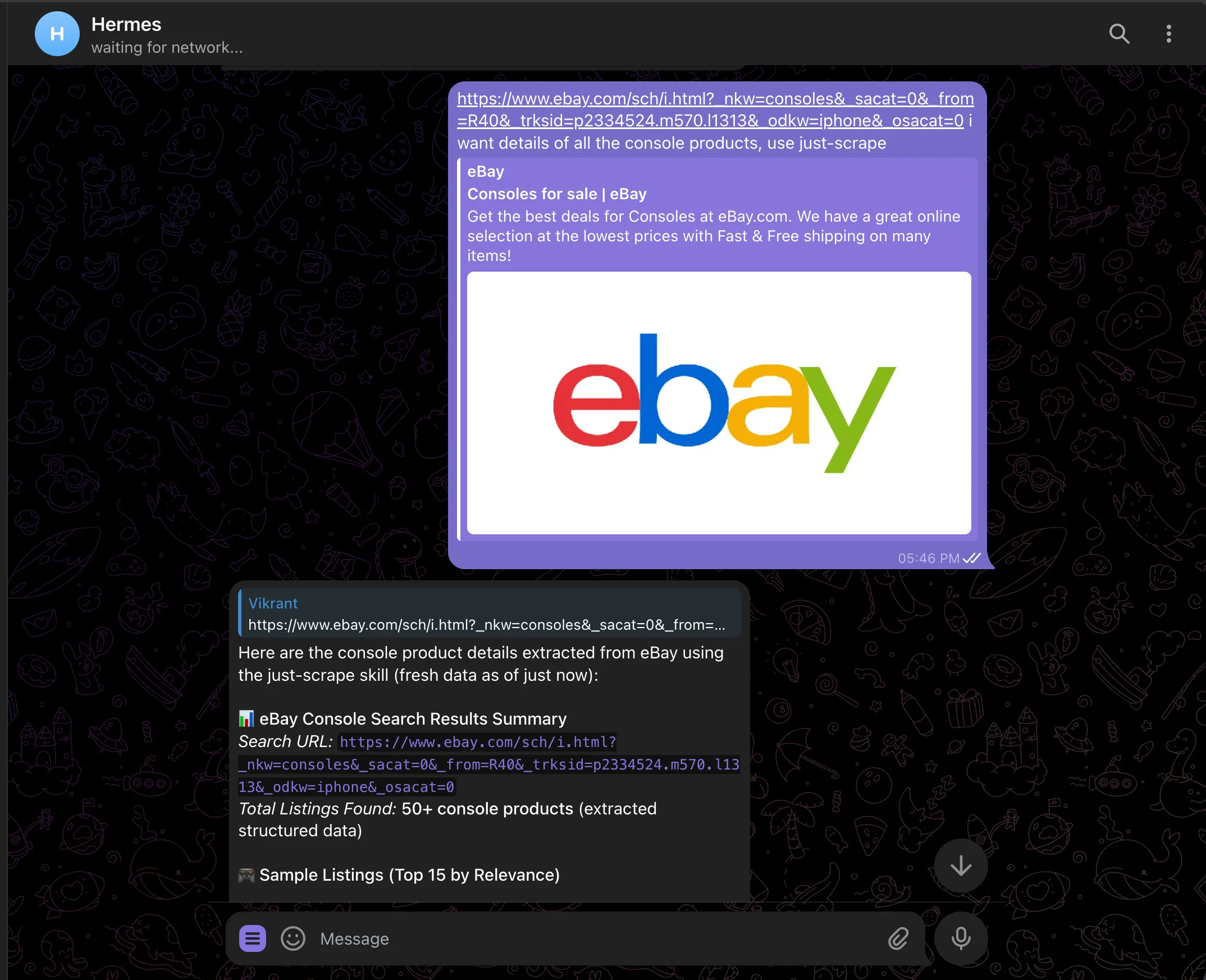
The interesting part is the next message. Because just-scrape returns schema-validated JSON, every listing comes back with the same fields in the same shape. No regex parsing, no markdown wrangling.
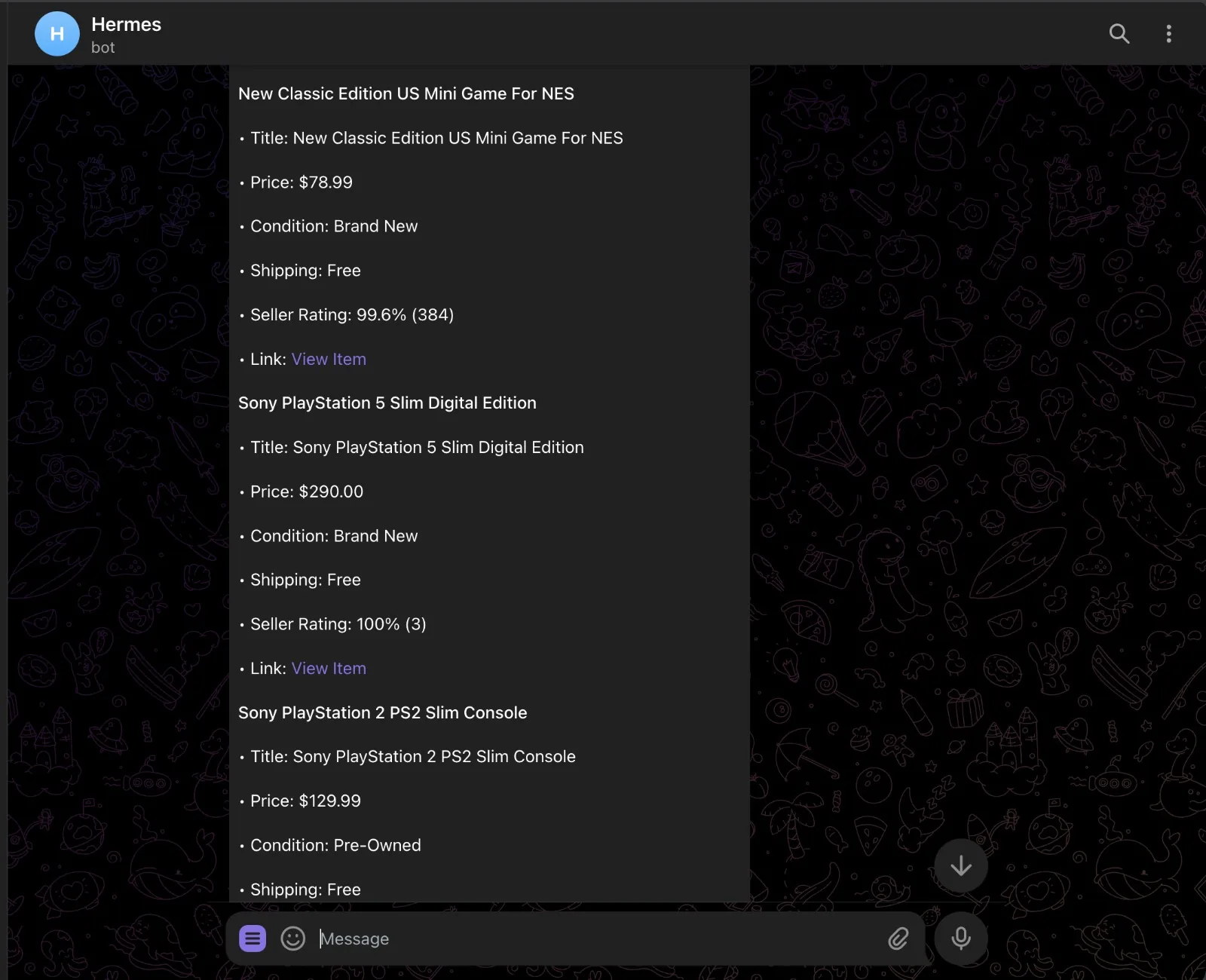
This is what makes just-scrape different from a generic HTML-to-markdown scraper. You get fielded data the agent can reason about, compare, and persist.
Step 4: Turn it into a recurring cron job
Hermes has a built-in cron scheduler. You can hand it a job in natural language and it figures out the schedule, prompt, and delivery target.
Stay in the same chat session so Hermes has the eBay context fresh, then send:
> Now set a cron for this to run every 3 hours and update me about new
  listings or price changes.
Hermes calls its cronjob tool, writes the job, and confirms back:
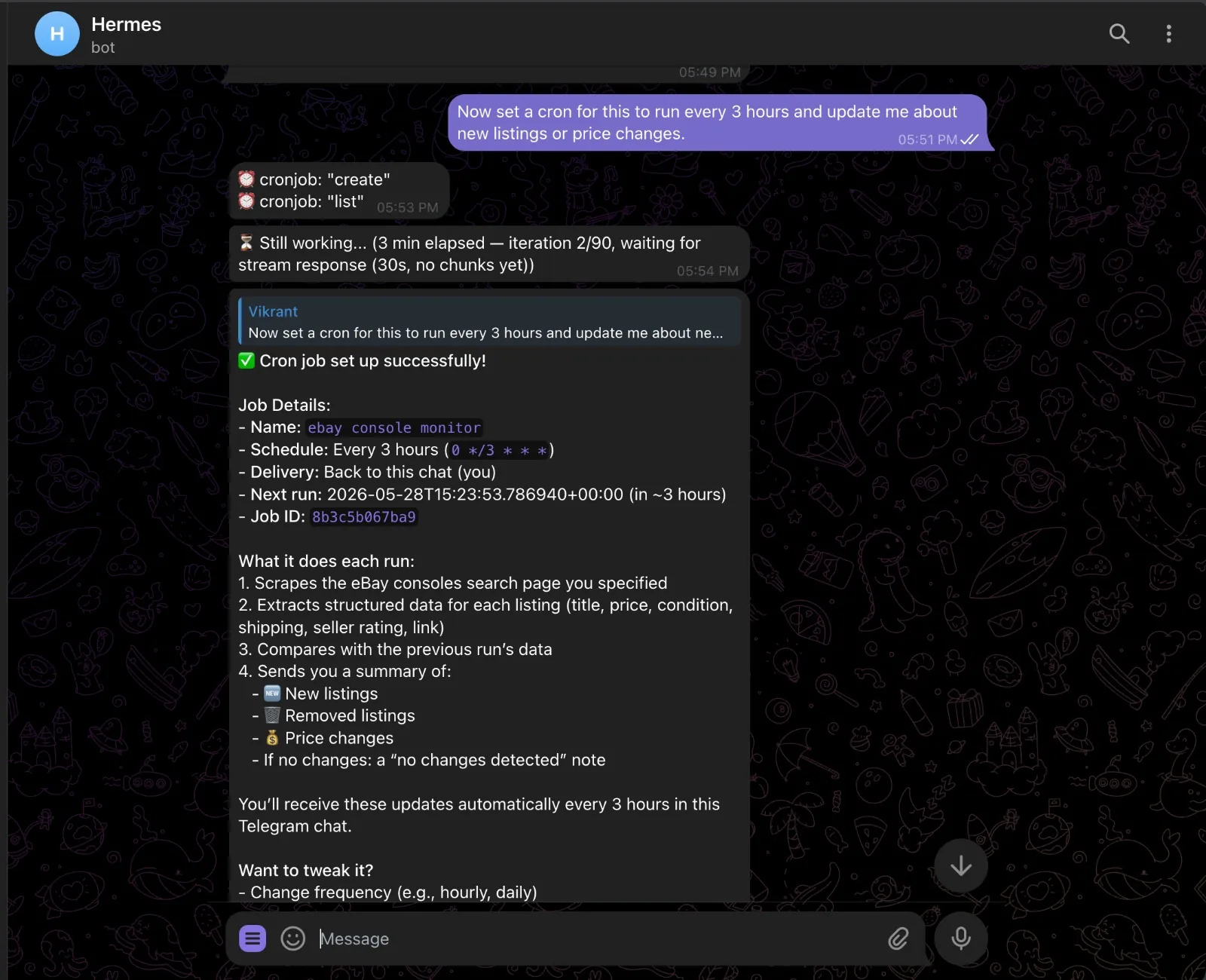
The job:
- Name:
ebay console monitor - Schedule:
0 */3 * * *(every 3 hours) - Delivery: back to the same Telegram chat
- Job ID: a short hash you can use to pause, resume, or remove the job later
Each run scrapes the eBay search page, compares the result with the previous run stored in memory, and sends a diff. New listings, removed listings, price changes. If nothing moved, you get a quiet "no changes" note instead of noise.
You can manage jobs from chat:
/cron list
/cron pause <job-id>
/cron resume <job-id>
/cron remove <job-id>
Or from the shell with hermes cron list. Cron sessions cannot create new cron jobs, so you cannot accidentally trigger runaway scheduling loops.
What else you can build
The eBay monitor is one shape of the same pattern: scrape, persist, compare, alert. Swap the URL and prompt and you have a different agent.
- Competitor pricing watch. Point it at a SaaS pricing page. Schema the plan tiers. Get a diff every Monday morning.
- Lead enrichment. Feed Hermes a CSV of company URLs. Have it scrape each homepage on a queue, extract company name, industry, headcount, and latest news, and append to a Google Sheet.
- Job board scraper. Watch a "remote senior Go" search on Wellfound or LinkedIn. New posting drops, you get a Telegram ping with the role, salary, and link.
- Release notes digest. Scrape changelog pages for tools you depend on. Daily digest of what shipped. No more missing breaking changes.
- News digest.
just-scrape search "AI news"on a morning cron, top 5 stories summarized, delivered before your first meeting.
Each of these is a five-minute build once just-scrape is installed. The only thing that changes is the prompt and the schedule.
Skills fit Hermes' learning loop. When the agent does something useful with just-scrape, it can write a new skill that bakes in the prompt, the schema, and the schedule. The next time you ask the same thing, Hermes is already faster.
Related Articles
- How to Use ScrapeGraphAI MCP with Claude Desktop - The same kind of integration for Claude users, via MCP.
- How to Use ScrapeGraphAI MCP with OpenAI Codex - Wire Codex CLI to the hosted MCP for terminal-native scraping.
- How to Use ScrapeGraphAI MCP with Gemini CLI - The Gemini CLI version, also MCP-based.
Conclusion
Hermes Agent plus just-scrape gives you an autonomous agent that watches the web on its own clock. One CLI install, one skill install, one natural-language prompt, and the agent does the rest.
Pick a URL that matters to your business, write the prompt once, set the cron, and let it run.