


TL;DR
A SERP is a Search Engine Results Page: what Google, Bing, or another engine shows after you search. You get organic links, ads, and SERP features like featured snippets, People Also Ask, knowledge panels, local packs, and AI Overviews. Once you can read that layout, turning it into structured data for SEO or product work is a lot less mysterious.
You already use SERPs constantly. You just rarely call them that. Type something, press Enter, get a page of links, ads, and random boxes. That page is the SERP.
SERP stands for Search Engine Results Page. People also say "the SERPs" when they mean result pages in general, not one frozen screenshot. The serp meaning is boring on purpose: it is the page between your query and the rest of the web.
This post stays definitional. What a SERP is, what sits on it, why two people can search the same phrase and see different pages, and why that layout matters if you do SEO or build products. If you already know the vocabulary and want extraction code, skip to Scraping Google Search Results with AI Agents.
What does SERP stand for?
No mystery in the acronym:
| Letter | Meaning |
|---|---|
| S | Search |
| E | Engine |
| R | Results |
| P | Page |
So "what is a SERP" and "serp meaning" land on the same answer: what shows up after a query, and how is it arranged?
A few terms travel with it:
- SERPs (plural): result pages across queries, engines, or devices
- Organic results: unpaid listings the engine ranks
- Paid results / ads: sponsored placements
- SERP features: everything that is not a plain blue-link row (snippets, packs, panels, AI answers)
If you can point at the page Google shows after a search, you are looking at a SERP. That is the whole bar.
Anatomy of a SERP
Modern SERPs are not ten blue links. They are a pile of blocks, and each block is there for a reason.
Organic results
Organic results are the classic ranked links: title, URL or breadcrumb, short description. Position 1 still matters, but it is often not the first thing you see. Ads, a featured snippet, a local pack, or an AI Overview can sit above it.
Most SEO work still targets organic ranking: one URL, one intent, a position you can track week to week.
Paid results and ads
Paid placements look like results and sit on the same page, but they are bought. They show at the top and bottom, often with "Sponsored" or "Ad" labels. Shopping ads can also show as product cards with prices and merchants.
Ads are part of the SERP. They take the same attention organic links want, even though a different system picks them.
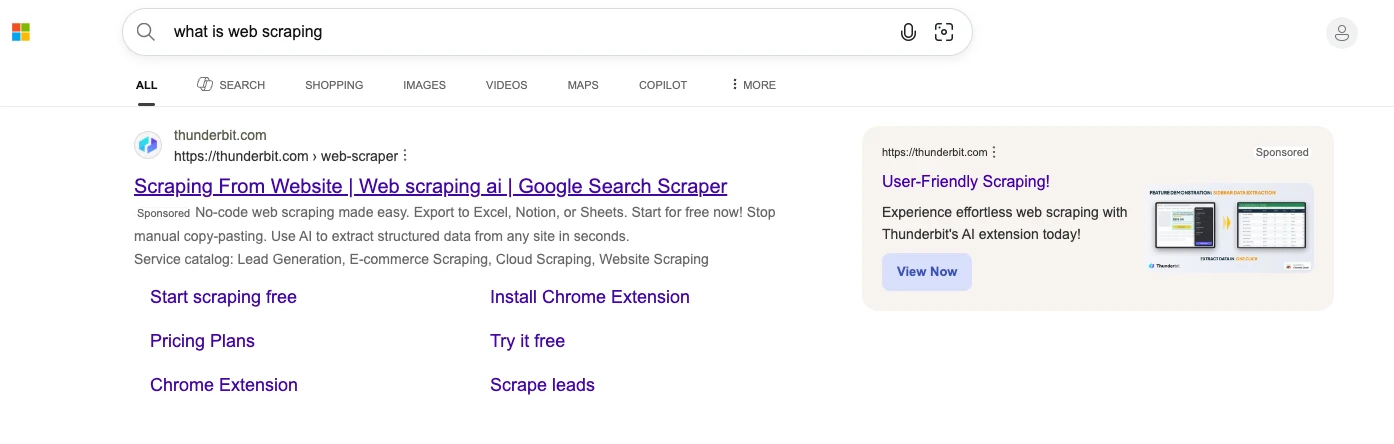
SERP features (the modules that break the old layout)
"SERP features" is the catch-all for everything that is not a standard organic listing. Common types:
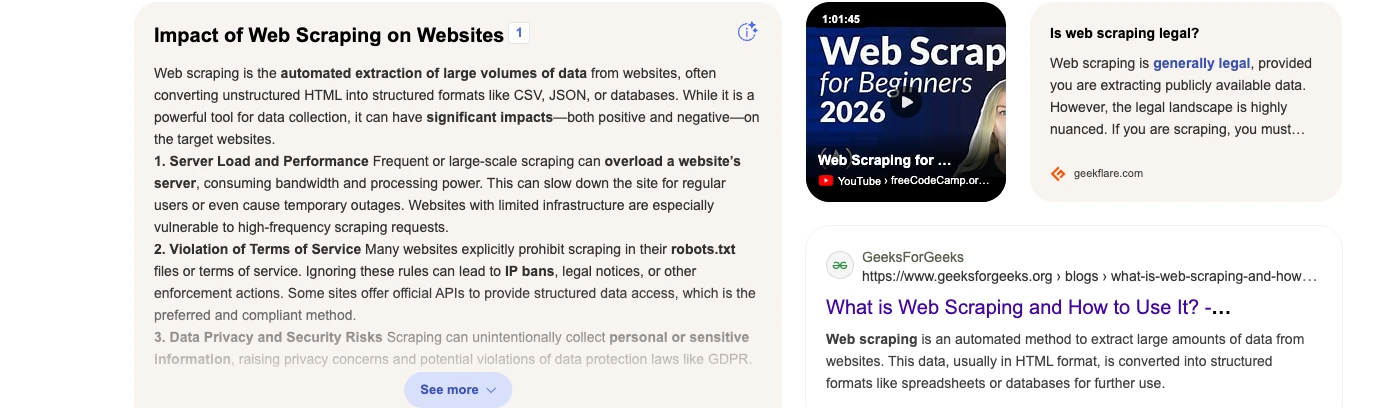
| Feature | What it is | Typical query shape |
|---|---|---|
| Featured snippet | Boxed answer taken from a page, often called position zero | definitions, how-tos, short facts |
| People Also Ask (PAA) | Expandable related questions | informational clusters |
| Knowledge panel | Entity card for a brand, person, place, or thing | named entities |
| Local pack | Map plus nearby businesses | "near me", local services |
| Image pack | Grid of images | visual topics |
| Video pack | Video carousels, often from YouTube | tutorials, reviews |
| Shopping results | Product cards with price and merchant | product and commercial queries |
| Top stories / news | News headlines | breaking or timely topics |
| AI Overviews | Generated summary blocks above or among classic results | broad informational queries |
You will not see all of these on one query. A brand name, a plumber "near me", and a "what is" definition produce totally different layouts. That is the useful part of serp features: the mix of modules is a rough map of intent.
AI Overviews in 2026 sit in the same bucket. They did not kill the SERP idea. They added another block that answers before, or next to, the blue links.
Organic vs paid results
Beginners collapse everything into "the first result." That habit causes bad reporting.
Organic results come from ranking systems. You push them with content, links, technical quality, and relevance. Paid results come from auctions and ad quality. You push those with bids, creatives, and landing pages.
Both live on one SERP. Both can shove organic listings down the screen. When someone says "we rank number one," ask what they mean: organic position 1, the first visible card, or the first ad. Those answers diverge more than people admit.
A boring scan that works:
- Mark ads and shopping units so you do not count them as organic.
- Find the first organic result.
- Note which SERP features sit above, between, or beside those organics.
Do that three times and half the beginner confusion disappears.
Why SERPs change for the same keyword
Same phrase, different page. Normal.
SERPs shift with:
- Location: city, country, and language change local packs and some rankings
- Device: mobile stacks modules differently and changes what is above the fold
- Personalization and history: signed-in state and past searches can nudge results
- Query interpretation: the engine guesses intent (informational, navigational, commercial, local) and rearranges features
- Time: news, product stock, and AI answer blocks move as the index and models update
A SERP is not a fixed document. It is a generated view for a query in a context. That is why rank trackers care about country, language, device, and timestamp, not only the keyword string.
If you only check rankings on your own laptop after months of related searches, you are not seeing what a cold user in another city gets. Easy trap. I still catch myself doing it.
Why SERP data matters
Once the blocks have names, the use cases stop feeling abstract.
SEO and content teams read SERPs to see which format the engine rewards. Heavy featured snippet and PAA? A long unstructured essay may be the wrong shape. Local pack owns the top? A national blog post will struggle for that intent no matter how clever the title is.
Competitive research starts here too. Who owns the organic top ten? Who is buying ads? Which domains show up in image or video packs? That is who already wins the click for that intent.
Rank tracking turns those observations into time series: position today versus last week, feature presence, URL swaps. Developers usually want rows in a database, not screenshots. For that path, see Rank Tracking API for Developers and the broader playbook in SEO Web Scraping: AI Keyword Research & SERP Analysis.
You do not need to scrape anything to get value from this. You need to stop treating the results page like a wall of links.
From SERP to structured data
After the definition, the engineering question shows up fast: can this page become JSON?
Yes. ScrapeGraphAI has a search endpoint (also called searchscraper) that runs a web query and returns parsed results as structured data. Useful when you already understand the layout and want machine-readable output instead of another screenshot.
One verified request shape:
curl -X POST https://v2-api.scrapegraphai.com/api/search \
  -H "SGAI-APIKEY: $SGAI_API_KEY" \
  -H "Content-Type: application/json" \
  -d '{"query": "best running shoes 2026", "numResults": 5}'
Body fields worth knowing:
query(required): the search stringnumResults: 1-20, default 3- optional
format:markdownorhtml - optional
prompt+schemawhen you want structured extraction on top of the search results
Auth uses the SGAI-APIKEY header. Plans start at Free ($0), then Starter ($20), Growth ($100), and Pro ($500). The response is parsed search output. For exact response fields, check the live API docs instead of guessing a fixed schema here.
I am stopping at the handoff on purpose. The full how-to for Google SERP extraction, schemas, and SEO workflows is in Scraping Google Search Results with AI Agents. If you are comparing dedicated SERP APIs to broader web extraction, ScrapeGraph vs SerperAPI: Web Data Extraction 2026 covers that tradeoff.
FAQ
What does SERP stand for?
SERP stands for Search Engine Results Page. It is the page a search engine returns after a query.
What is the difference between SERP and SERPs?
SERP is one results page. SERPs is the plural, used for result pages in general or across many keywords.
What are SERP features?
SERP features are modules beyond classic organic listings: featured snippets, People Also Ask, knowledge panels, local packs, image and video packs, shopping units, news blocks, and AI Overviews, among others. Which ones appear depends on the query and context.
Are ads part of the SERP?
Yes. Sponsored results and shopping ads sit on the same results page as organic listings. They change what users see first even when they are not organic rankings.
What is a good SERP position?
Depends on the layout. Organic position 1 is strong, but a featured snippet, local pack, or AI Overview can steal more attention than the first blue link. Judge "good" by visibility for your intent, not by a bare number with the rest of the page stripped out.
Is a SERP only a Google thing?
No. Google gets most of the airtime, but Bing, DuckDuckGo, and other engines produce SERPs too, each with their own layout quirks. The acronym is engine-agnostic even if SEO chat defaults to Google. If you need to monitor positions on Microsoft's engine, the Bing rank tracker guide shows the API workflow.