


TL;DR
SerpApi's core plans run from $25/month for 1,000 searches to $275/month for 30,000, which works out to 2.5 down to 0.9 cents per successful search. The free plan includes 250 searches per month.
The quiet costs: Ludicrous Speed doubles every price and Ludicrous Speed Max quadruples it for the same search volume, U.S. Legal Shield only starts at the $150 plan, and there is no overage rate. Running out mid-month means buying your whole plan again early.
SerpApi sells structured Google results as JSON. You send a query, it returns organic results, ads, the local pack, knowledge graph data, and whatever else the SERP contains, parsed into fields. The pricing model is simple on the surface: every plan is a monthly bucket of searches. The details are where budgets go wrong, so this guide walks through every number on the pricing page as of August 2026 and the billing rules behind them.
I verified each figure directly on the live page while writing this. Prices change, so treat SerpApi's own checkout as the source of truth and this article as the map of what to check.
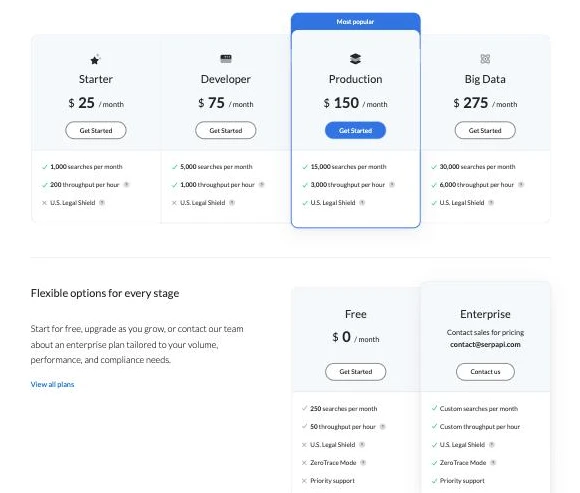
SerpApi Pricing Plans in 2026
The four advertised plans cover most self-serve buyers:
| Plan | Price/month | Searches/month | Throughput/hour | Per search |
|---|---|---|---|---|
| Free | $0 | 250 | 50 | $0 |
| Starter | $25 | 1,000 | 200 | 2.5¢ |
| Developer | $75 | 5,000 | 1,000 | 1.5¢ |
| Production | $150 | 15,000 | 3,000 | 1.0¢ |
| Big Data | $275 | 30,000 | 6,000 | 0.92¢ |
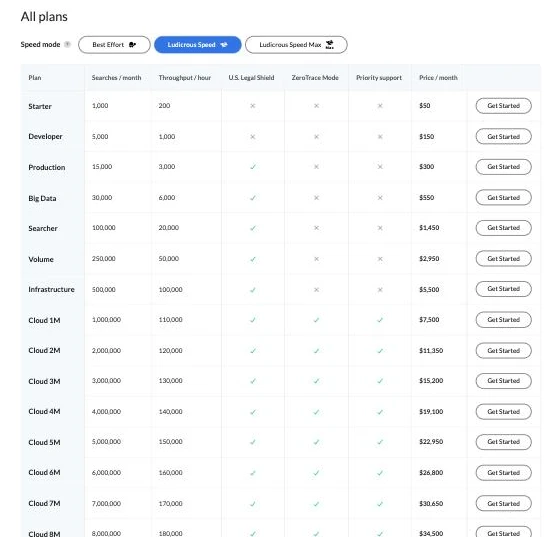
Above Big Data, the full plan table keeps going: Searcher at $725 for 100,000 searches, Volume at $1,475 for 250,000, Infrastructure at $2,750 for 500,000, then Cloud tiers from 1 million searches at $3,750 up to 54 million at $106,050 per month. Per-search cost falls the whole way, from 2.5 cents on Starter to about 0.2 cents at the top of the Cloud range.
Two things stand out against competitors like the ones covered in our scraper API comparison. First, the free plan is a real monthly allowance of 250 searches, not a one-time trial. Second, throughput is a first-class plan limit: Starter caps you at 200 searches per hour, so a burst-heavy job can hit the hourly wall long before the monthly one.
The Speed Tier Multiplier
This is the number most SerpApi pricing summaries skip. The plan table has a speed mode selector with three settings, and it multiplies the price of every plan while the search counts stay identical:
| Plan | Best Effort | Ludicrous Speed | Ludicrous Speed Max |
|---|---|---|---|
| Starter (1,000) | $25 | $50 | $100 |
| Developer (5,000) | $75 | $150 | $300 |
| Production (15,000) | $150 | $300 | $600 |
| Big Data (30,000) | $275 | $550 | $1,100 |
Ludicrous Speed is exactly 2x the base price and Ludicrous Speed Max is 4x, for the same number of searches. The tiers buy faster processing for latency-sensitive workloads. If your application waits on SerpApi responses in real time, budget for one of the fast tiers from the start, because the same 5,000 searches cost $75, $150, or $300 depending on how quickly you need each answer back.
For batch work like nightly rank tracking, Best Effort is usually fine and the multiplier is money you do not need to spend.
How Searches Are Counted
SerpApi's counting rules are genuinely customer-friendly, and they matter for cost modeling:
- Only successful searches count. Cached, errored, and failed searches do not consume quota.
- One response is one search regardless of size. A response with 100 results and an empty result set both cost exactly one search.
That second rule rewards requesting more results per query. If you can get 100 organic results in one search instead of paginating through ten searches of ten, you cut that workload's cost by 90%. Structure your queries around the largest useful page size before you size a plan.
No Overage, Just Early Renewal
SerpApi has no per-search overage rate. When you use up your monthly searches, you have two options: renew the plan early by hand, or turn on Automatic Early Renewal, which re-purchases your plan the moment the bucket empties and moves your renewal date.
The trap is in the math. Say you run 6,000 searches a month on Developer. After 5,000 the plan renews early, so you pay $75 twice: $150 for 6,000 searches, the same money that would have bought 15,000 searches on Production. Anyone consistently overshooting a plan by even 20% is better off one tier up. Check your last three months of usage before renewing, because the early-renewal pattern quietly converts a small overshoot into a doubled bill.
The refund policy is tight too: full refund within 7 days of subscribing, and only if you have used less than 20% of your searches.
What the Feature Gates Cost
The plan cards all advertise the same three features, but the comparison table shows where they actually switch on:
U.S. Legal Shield starts at Production ($150/month). Free, Starter, and Developer do not include it. SerpApi describes the shield as taking on the legal liability of scraping and parsing search results for you, so if that protection is why you picked SerpApi over running your own SERP scraping, the real entry price is $150, not $25.
ZeroTrace Mode and priority support only appear at Cloud 1M ($3,750/month) and Enterprise. ZeroTrace is SerpApi's no-logging mode, where search parameters and results are not stored after the search completes.
The certifications apply across the board: SOC 2 Type II, SOC 3, and ISO 27001, with uptime SLAs up to 99.97% on the higher tiers. The customer logos on the pricing page include NVIDIA, Shopify, Ahrefs, and Salesforce, which tells you who the upper plan tiers are built for.
What a Real Workload Costs
Some concrete scenarios, priced at Best Effort:
- Rank tracking, 500 keywords daily: 500 searches x 30 days = 15,000 searches. That is exactly the Production plan: $150/month. Track desktop and mobile separately and you are at 30,000, which is Big Data at $275. If you are building this kind of tool, our rank tracking API guide shows the extraction side of the pipeline.
- Daily brand monitoring, 50 queries: 1,500 searches a month. Starter's 1,000 is not enough, so you either trim to 33 queries a day or pay Developer's $75 and use 30% of it. Plan granularity is real money at the low end.
- A one-off research pull of 200 SERPs: the free plan, run over one day inside the 50-per-hour throughput cap. $0.
The pattern: SerpApi prices cleanly when your volume happens to sit near a plan boundary and painfully when it sits just past one.
SerpApi vs ScrapeGraphAI: Paying for SERPs vs Paying for Answers
SerpApi and ScrapeGraphAI both start from a search query, but they sell different layers of the job, and the right choice depends on which layer you actually need.
SerpApi sells the SERP itself. You get the raw structure of the results page: positions, ads, local pack, knowledge graph, shopping results. If your product is rank tracking, ad monitoring, or SERP feature analysis, that raw layer is the product, and at 1.0 to 1.5 cents per search on the mid plans it is priced well for it.
ScrapeGraphAI sells what comes after. For most teams, the SERP is step one of a longer pipeline: search, open the top results, extract the data you actually wanted. With SerpApi that second step is your problem. You still need a scraping stack with proxies, parsing, and retries for every result page you open. ScrapeGraphAI's search service collapses the pipeline into one call: it runs the search, visits the results, and returns structured data extracted from those pages, with references. Search costs 2 credits per result as a plain result list or 5 credits per result with extraction, and the Starter plan is $20/month for 10,000 credits.
The comparison in practice:
| Job | SerpApi | ScrapeGraphAI |
|---|---|---|
| 5,000 raw SERPs/month | $75 (Developer) | Wrong tool, SERP structure is not the product |
| "Get pricing data from the top 10 results for 200 queries" | $3 of searches, plus your own scraper for 2,000 pages | 200 x 50 credits = 10,000 credits, the $20 Starter plan |
| Overflow month | Full plan re-purchase via early renewal | Credit packs from $5 per 1,000 credits |
| Faster responses | 2x to 4x plan price | No speed-based price tiers |
Two honest notes on that table. If you need raw SERPs at six-figure monthly volume, SerpApi's unit price is hard to beat with an extraction tool, and that is the workload it is built for. And ScrapeGraphAI credits are shared across scraping, extraction, crawling, and monitoring, so the same balance that runs searches also runs the rest of the pipeline. The full credit model is in our ScrapeGraphAI pricing guide.
When SerpApi Pricing Works in Your Favor
- Your product consumes SERP structure directly: rank trackers, SERP feature monitors, ad intelligence tools.
- Your volume sits near a plan boundary, especially the Production plan's 1 cent per search.
- You can batch requests at 100 results per search instead of paginating.
- Your jobs run on schedules where Best Effort speed is fine.
- You want the legality question handled and you are at $150/month or above, where U.S. Legal Shield applies.
The inverse cases are just as clear. Latency-sensitive applications pay 2x to 4x through the speed tiers. Spiky usage pays through early renewals. Sub-1,000-search projects pay Starter prices for Developer needs. And pipelines that only use the SERP as a stepping stone to the pages behind it pay for SerpApi and a scraping stack.
FAQ
How much does SerpApi cost in 2026?
The advertised plans are $25/month for 1,000 searches, $75 for 5,000, $150 for 15,000, and $275 for 30,000, with volume tiers continuing up to $106,050/month for 54 million searches. Ludicrous Speed doubles those prices and Ludicrous Speed Max quadruples them.
Does SerpApi have a free plan?
Yes. The free plan includes 250 successful searches per month at 50 searches per hour. It does not include U.S. Legal Shield, ZeroTrace Mode, or priority support.
What happens if I run out of searches mid-month?
There is no overage rate. You renew the plan early, manually or through Automatic Early Renewal, which re-purchases the full plan and shifts your renewal date. Consistent overshooting costs more than upgrading one tier.
Do failed SerpApi searches count against my quota?
No. Only successful searches are counted. Cached, errored, and failed searches are free, and a response counts as one search whether it returns 100 results or none.
Is there a cheaper way to get data from search results?
If you need the data on the pages behind the SERP rather than the SERP itself, an extraction API can replace the search-plus-scraper pipeline. ScrapeGraphAI's search service returns structured data extracted from the top results in one call, at 5 credits per result on plans starting at $20/month.