


TL;DR
- Choose a Bright Data alternative by the job: proxy access, managed page retrieval, a ready-made scraper or custom structured extraction.
- Compare the same billing unit and workload. GB, requests, credits and accepted records measure different things.
- Test a representative sample before migrating, including failures and missing fields. The seven options below serve different needs; none is a universal cheapest replacement.
Bright Data pricing depends on the product you buy. A residential proxy, a browser session, a search result, and a structured product record have different billing units. There is no useful universal answer to “What does Bright Data cost for 100,000 requests?” until you specify which of those requests you mean.
The seven alternatives below cover different replacement jobs: ScrapeGraphAI for custom structured extraction, Oxylabs and Decodo for proxy or scraping infrastructure, ScraperAPI and Crawlbase for managed collection, Apify for packaged scraping workflows, and Crawl4AI for a stack you operate yourself.
ScrapeGraphAI publishes this comparison. The selection advice is our assessment of the vendors' documented features; this is not a head-to-head performance benchmark.
Bright Data pricing: identify the product and unit
Bright Data sells structured Scraper APIs and datasets as well as proxies and browser infrastructure. Include those structured products when the job is to obtain finished records.
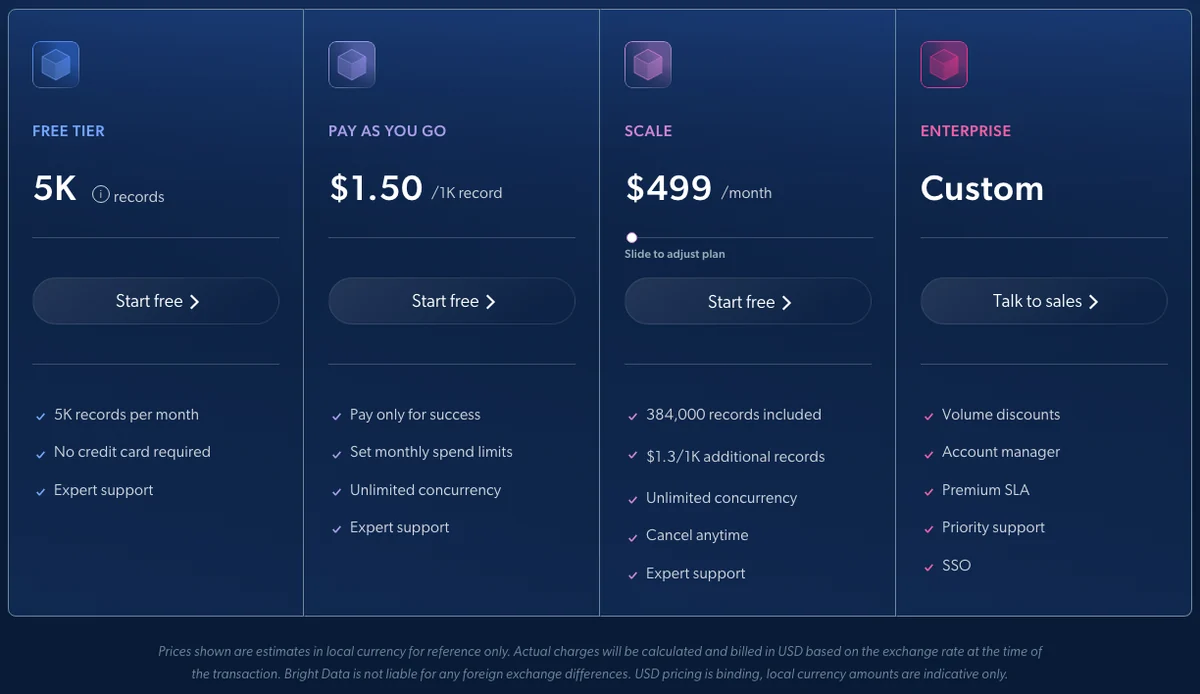 The Web Scraper API uses record-based billing, with separate pay-as-you-go and monthly plans. Source: Bright Data’s current pricing page.
The advertised starting rates from the official pricing page use different billing units:
| Product | Advertised starting rate | What to verify for your workload |
|---|---|---|
| Residential proxies | $2.50 per GB, shown as a promotion | Traffic volume tier, promotion duration, and payload size |
| Web Unlocker | $1 per 1,000 requests | Billing definition and target requirements |
| SERP API | $1 per 1,000 requests | Search type, location, and required result fields |
| Browser API | $5 per GB | Browser traffic and resources loaded per session |
| Scraper API | $0.75 per 1,000 records | Supported dataset, minimums, and record definition |
| Datasets | $250 per 100,000 records | Dataset scope, freshness, and delivery terms |
These are entry prices, not a quote for every customer or target. The residential rate includes a temporary promotion. Confirm the applicable rate and terms before estimating your workload's cost.
If you already use a Bright Data scraper that returns the fields you need, compare it with another structured-data service. If you rely on proxy sessions, compare the same location, session behavior, and traffic volume. An extraction API is not a drop-in replacement for arbitrary browsing through a proxy.
Seven alternatives and the work each one replaces
1. ScrapeGraphAI for a custom extraction schema
ScrapeGraphAI fits a workflow where you have a URL and want fields such as a product title, price, identifier, and availability. You provide a prompt and optional JSON Schema; the application still needs to validate the returned values against its own requirements. The Extract documentation describes that request model.
This is worth testing when maintaining parsers across different page layouts is taking significant time. It does not establish that every target is accessible or that a redesign can never change the result. Missing fields, wrong variants, and access failures still need monitoring.
The pricing page lists Starter at $20 per month for 10,000 credits, Growth at $100 for 100,000 credits, and Pro at $500 for 750,000 credits. A base extraction costs five credits; stealth adds five. Consequently, 10,000 Starter credits cover at most 2,000 base extraction calls before other usage, or 1,000 calls with stealth. Credits and pages are not interchangeable.
Use the tested product example to inspect a real request, its expected fields and the exported record before evaluating your own URLs.
2. Oxylabs for proxy access or managed scraping
Oxylabs offers both proxies and a Web Scraper API. Its pricing page lists Web Scraper API plans starting at $49 per month and residential proxy pricing separately. You therefore have the same initial decision as with Bright Data: keep your retrieval stack and replace the network, or move collection into a managed API.
Shortlist it when geography, session control, or an existing parser determines your requirements. For a managed API trial, compare returned fields and target coverage rather than assuming all pages use the advertised base result price. The usage and billing documentation is the place to confirm those conditions.
This guide does not claim faster support or a higher success rate than Bright Data. Those require evidence from the support arrangement and workload you would actually buy.
3. ScraperAPI for managed retrieval and supported structured outputs
ScraperAPI can retrieve pages for an existing parser and also offers structured data products. Its pricing page lists Hobby at $49 per month with 100,000 API credits, Startup at $149 with 1,000,000, and Business at $299 with 3,000,000. The advertised 5,000-credit entry offer is a seven-day trial, not a recurring free monthly allowance.
Check the target-specific credit cost before dividing the subscription price by the credit allowance. Rendering and target requirements affect how much collection the allowance buys. If a supported structured endpoint already matches your target, test that endpoint as well as the HTML response; doing so avoids adding a parser unnecessarily.
It belongs on the shortlist for a team that wants to retain its existing extraction logic while changing how pages are fetched.
4. Apify for a maintained Actor or a custom scheduled workflow
Apify combines a marketplace of Actors with a platform for running your own automation. An Actor may already handle the inputs, pagination, and output structure for your source. That can reduce the amount of integration work, but the specific Actor's documentation and maintenance history matter more than the marketplace's size.
Apify pricing lists Starter at $19 per month plus usage beyond its included amount. Platform compute and Actor pricing are separate considerations. A compute unit measures one GB of allocated memory used for one hour; some Actors use their own result or event billing model.
Inspect an Actor's input schema, sample dataset, recent changes, and pricing terms. Test whether a rerun produces duplicate records and whether missing pages appear as failures. A subscription price alone cannot tell you the cost of a particular Actor run.
5. Decodo, formerly Smartproxy, for proxies and a scraping API
Smartproxy is now Decodo. Its offering includes proxies and a Web Scraping API, so older comparisons that describe it only as a smaller proxy network are incomplete.
The Web Scraping API introduction describes managed proxy rotation, rendering, and anti-bot handling. Use the current pricing plans to identify whether your quote is based on bandwidth or requests.
Decodo is a candidate when you want to compare proxy access without rebuilding your collector, or test a managed scraper for a defined target. Do not infer that its cheapest per-GB tier will be cheaper for your application: geographic requirements and the amount of content loaded can change that comparison.
6. Crawlbase for API collection and queued delivery
Crawlbase provides a Crawling API and an asynchronous crawler, along with other collection tools. Its API reference describes the distinction between making a request directly and submitting work to a queue.
The Crawling API documentation distinguishes the target's status from Crawlbase's own status and defines billable outcomes. Some target 404 and 410 responses can be billable. A “successful request” on an invoice therefore does not necessarily mean a usable product record reached your database.
Evaluate it when asynchronous delivery, retries, or collection throughput is a substantial part of your integration. Reconcile billing against accepted records, and account for domain complexity rather than assuming one request price applies to every source.
7. Crawl4AI for control over the collection stack
Crawl4AI is an open-source crawler with browser-based fetching, Markdown output, and extraction strategies. Running it yourself puts browser installation, workers, network access, storage, and operational monitoring under your control.
That can suit a team with infrastructure ownership requirements or existing capacity to operate browsers. Open-source software does not make compute, proxies, model inference, or engineering time free. Compare the full operating cost with a managed service, including the person responsible when a run stops producing records.
Use a representative test to measure resource consumption. A blanket estimate for the monthly cost of one server is not evidence that it can handle your target mix or required completion window.
Compare 100,000 records without inventing a benchmark
Define the workload before requesting quotes. For example: 100,000 product detail pages per month, one market, one variant per URL, title plus identifier plus displayed price, collected within a 24-hour window. Decide whether a missing price is an accepted record, a partial record, or a failure.
The following is arithmetic with hypothetical inputs, not measured vendor performance:
| Assumption | Calculation | Result |
|---|---|---|
| 100,000 fetches averaging 0.3 MB, decimal units | 100,000 × 0.3 MB ÷ 1,000 | 30 GB |
| The same fetches averaging 3 MB | 100,000 × 3 MB ÷ 1,000 | 300 GB |
| 100,000 base SGAI extracts, no other usage | 100,000 × 5 credits | 500,000 credits |
| Half those extracts also use stealth | 500,000 + 50,000 × 5 | 750,000 credits |
A tenfold difference in transferred bytes changes bandwidth costs substantially. Credit multipliers can have a similar effect on API allowances. Neither calculation tells you how many records meet your quality requirements.
For the pilot, record attempted URLs, accepted records, field errors, elapsed time, billed usage, and manual repair time. Calculate total operating cost per accepted record. The web scraping economics calculator includes migration and engineering costs without assuming a provider will save a fixed percentage.
Migrate one workload and keep a rollback path
Choose a source that represents a meaningful share of your traffic. Include its difficult cases: missing fields, pagination, different variants, and pages that no longer exist. Send the same bounded sample through the existing system and the candidate, then compare both with a manually reviewed reference.
Keep the output schema stable while changing the collector. Route the new results to a staging table until duplicate handling, timestamps, and failure reporting are verified. Switch that source only after the candidate meets the criteria you set before the test. Preserve the old configuration long enough to roll back if live behavior differs from the pilot.
A migration may reduce cost, improve field coverage, or simplify maintenance. It can also be a poor use of time when an existing Bright Data integration already meets the required quality and budget. The decision should follow the workload evidence, not a promised percentage saving.
Questions to resolve before choosing
Which Bright Data alternative is cheapest? There is no provider-independent answer. Compare the same target mix, output fields, geography, accepted-record definition, and completion window, then include unused subscription capacity and engineering time.
Can an extraction API replace a residential proxy? It can replace a collection task when its supported request and response cover that task. It does not replace every use of an authenticated browser or a general-purpose proxy connection.
Will AI extraction remove maintenance? It can change which parts you maintain. Schema checks, source access, drift detection, and downstream validation remain your responsibility.
Should a working Bright Data scraper be replaced? First establish the problem: cost, missing data, operational burden, or a requirement it cannot meet. A migration without a measurable problem has no clear success criterion.